
Landscape (Ōhara Landscape) — History & Facts
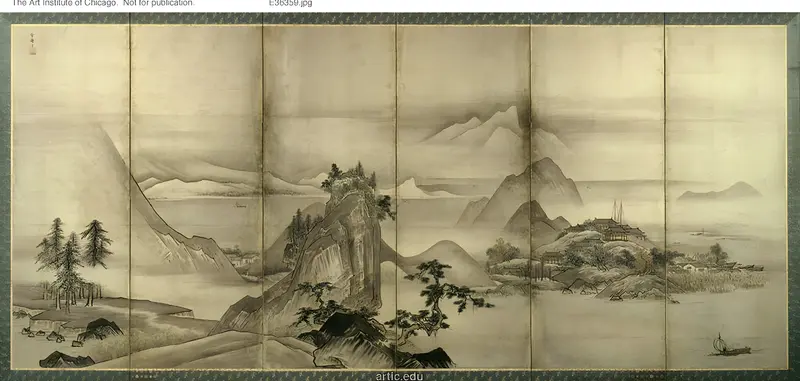
A mountainous landscape rendered in ink and light color on paper forms the lower portion of Landscape (Ōhara Landscape), attributed to Sesshu and dating to the Muromachi period (1337–1573). The composition features steep, rugged cliffs and rocky outcrops, with a cluster of trees and a traditional building nestled among the slopes. Above, a large expanse of open space is dominated by calligraphic inscriptions and red seals, which balance the image vertically and introduce a textual element to the work. The artist employs controlled brushwork to define the forms of rocks, trees, and architecture, using tonal washes to suggest atmospheric perspective and depth.
The landscape is rendered with a restrained palette, primarily monochrome ink with subtle touches of color in the foliage and architectural details. The scene is composed with an emphasis on verticality, characteristic of hanging scrolls, and the placement of the buildings and trees draws attention to the harmonious integration of human presence within nature. Landscape (Ōhara Landscape) belongs to the Ōhara family collection in Kurashiki, Okayama Prefecture. The work is representative of the ink landscape tradition in Japan during the Muromachi period, a time when Chinese-inspired monochrome painting flourished under Zen Buddhist influence.
More Artworks by Sesshu

More Landscape Art

The Starry Night
Vincent van Gogh

View of Delft
Johannes Vermeer

Water Lilies
Claude Monet

The Grand Canal, Venice, looking north-west from the Ca' Corner to the Ca' Contarini degli Scrigni, with the campanile of Santa Maria della Carità
Canaletto

Windsor Castle
Canaletto

The Grand Canal looking North-East from the Palazzo Dolfin-Manin to the Rialto Bridge
Canaletto