Landscape with sheaves — History & Facts
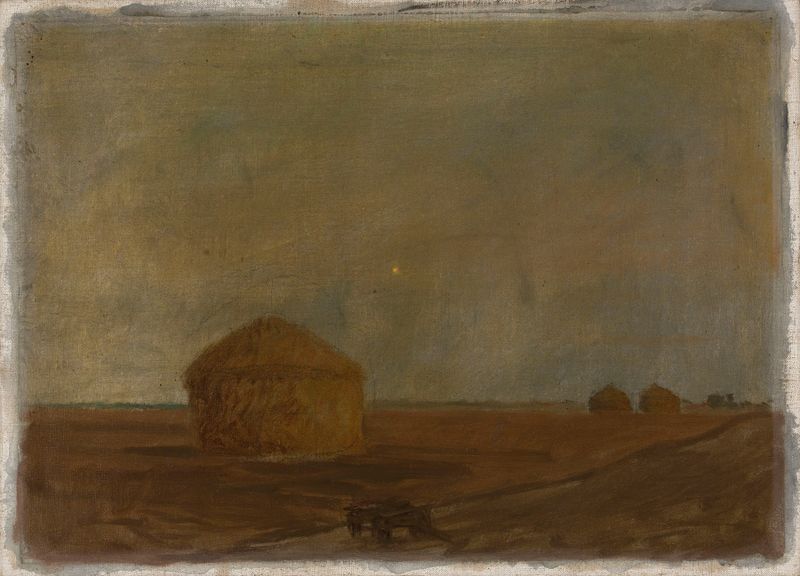
In the stillness of a painted landscape, we confront the whispers of loss that linger between the strokes of the brush. Here, nature’s bounty stands as a testament to time, suggesting both abundance and the inevitable fading that follows. Focus on the vibrant sheaves of golden wheat arranged in the foreground, where they rise like sentinels against the tranquil backdrop. The brushwork captures the gentle undulation of the land, while the warm palette of yellows and soft greens invites both comfort and contemplation.
Notice how the light cascades through the scene, bathing the sheaves in a glow that hints at past harvests; it's a poignant reminder of what was once cherished. Delve deeper into the shadows that dance along the edges of the canvas, hinting at what has been lost amidst the beauty. The juxtaposition of the thriving sheaves and the encroaching distance reflects the transient nature of life; it speaks to the bittersweet passage of time. This work encapsulates a moment that feels both alive and haunting, suggesting that even in abundance, a quiet sorrow resides, echoing the impermanence of existence. Created during an era of artistic exploration, the painter worked during a time when Germany was navigating the complexities of modernity.
While the exact date of this piece remains elusive, it is likely that it was conceived around the late 19th century, a period marked by both personal and societal transformations. Kalckreuth’s engagement with landscapes reflects a broader artistic pursuit, where the natural world became a mirror for human emotion and societal change.