Landschaft in Württemberg — History & Facts
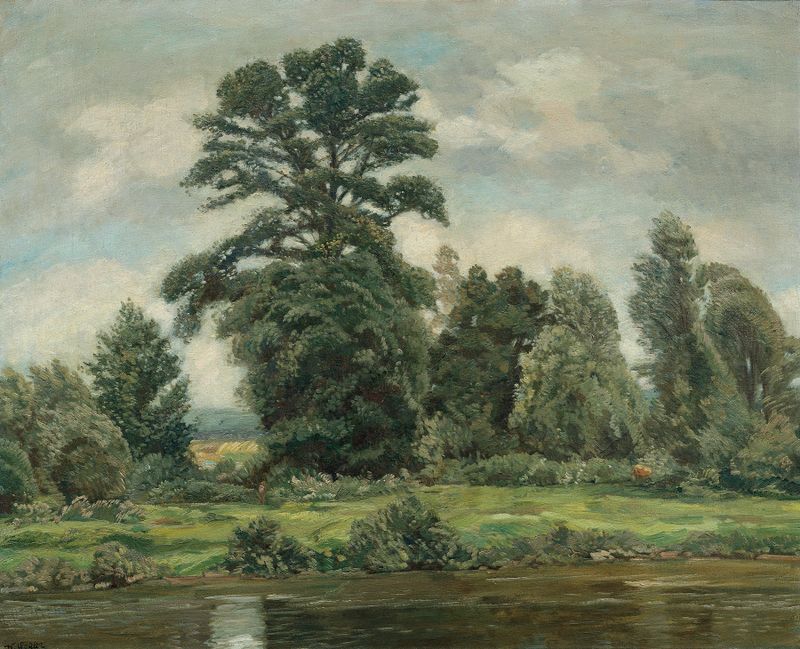
In a world teetering on the brink of revolution, landscapes can whisper secrets that words cannot convey. They encapsulate the shifting tides of emotion and the silent struggles of the human spirit. Look closely at the interplay of greens and grays in Landschaft in Württemberg. Notice how the bold strokes of the trees stand in stark contrast to the soft, muted sky above, creating a sense of tension between the forces of nature.
The horizon is painted with a delicate precision, drawing the eye toward the distant hills that seem to beckon, yet remain out of reach. The artist’s technique balances both wild expression and serene contemplation, inviting the viewer to immerse themselves in the tranquil yet charged atmosphere. In the foreground, small details emerge: a subtle play of light on the leaves and the gentle undulation of the land suggest life beneath the surface. Here, a sense of unease lingers, as if the landscape itself is holding its breath — preparing for change.
The painting captures not just a physical space, but a metaphor for the transformation sweeping across society, where beauty and turmoil coexist. Created during an undefined period, Landschaft in Württemberg reflects Wilhelm Legler’s search for identity in a rapidly changing world. His work emerged at a time when the boundaries of tradition were being challenged, and artists sought to depict not just beauty, but the deeper truths of their existence. As the art world began to embrace new movements and ideas, Legler's landscapes became a canvas for both personal and collective revolutions.