Landschap met een brug waarop een hengelaar — History & Facts
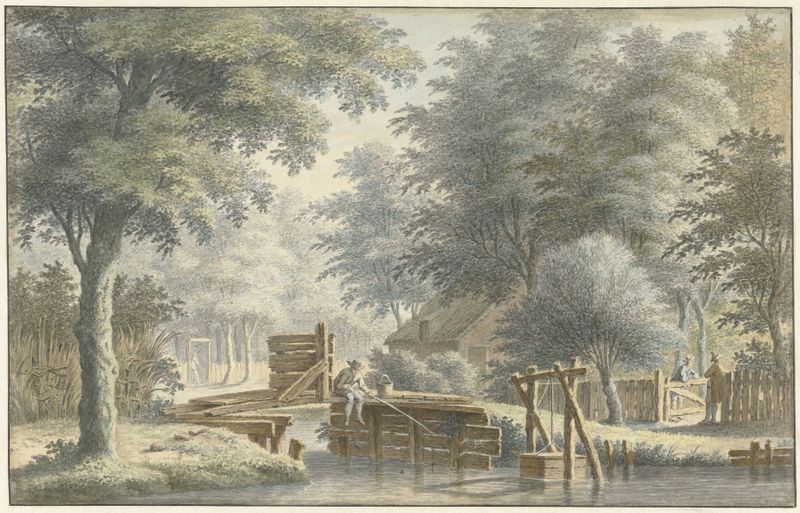
Can paint confess what words never could? In the soft embrace of twilight, a bridge stretches across the canvas, a silent witness to the passage of time and the unrelenting decay of nature. Below, the water reflects the muted hues of the fading day, while a solitary fisherman stands poised, embodying stillness amid the gentle movement of the water. Look to the left where the bridge gracefully arches over the stream, guiding your eye into the depth of the landscape. Notice how the light falls delicately, illuminating the edges of the bridge and casting long shadows on the water.
The artist employs a palette of earthy tones—olive greens and muted grays—adding a layer of melancholy to the scene. The meticulous brushwork captures the textures of the landscape, as if each stroke whispers the secrets of the decay that seeps into the surroundings. The composition contrasts the man’s presence with the inevitable wear of the landscape. The aging bridge symbolizes the fragile connection between man and nature, while the fisherman, seemingly at peace, hints at the fleeting nature of existence.
Look closer at the ripples in the water; they echo the fisherman’s quiet solitude, suggesting that life continues despite the passage of time and the decay of everything around it. In 1763, Gerard van Rossum created this piece during a time when artists were increasingly drawn to the beauty of nature and its transient qualities. Working in the Netherlands, he explored the emerging Romantic sensibilities, reflecting a shift in how landscapes were depicted. As the world embraced new ideas, his work stands as a testament to the complex relationship between humanity and the natural world, capturing the essence of a moment that resonates with decay and reflection.