
Landschap met figuren en vee — History & Facts
Art reveals the soul when the world turns away. In the stillness of a landscape, the emptiness speaks louder than any bustling crowd, whispering secrets of solitude and longing. Look to the center of the canvas, where gentle hills rise and fall like the breath of nature. The muted greens and browns form a tranquil backdrop, punctuated by the figures of livestock grazing, their silhouettes merging with the earth.
The soft application of paint allows the light to play delicately across the scene, creating depth and inviting the viewer to explore the horizon where the sky meets the land. Yet, beneath this idyllic surface lies an unsettling contrast. The presence of cattle alongside solitary human figures evokes a sense of isolation amidst a sprawling world. The figures appear almost ghostlike, their postures suggesting a search for connection in an expanse that feels infinitely empty.
Each brushstroke captures a fleeting moment of existence, rendered poignant by the surrounding vastness that amplifies their solitude. During the 1790s, Landschap met figuren en vee was created by Georges Michel amidst the shifting tides of art and society in France. As the Romantic movement began to emerge, artists were increasingly drawn to the themes of nature and human emotion, reflecting a world on the brink of change. Michel, working in a time of personal and political upheaval, sought to encapsulate the essence of this moment—a meditation on human existence set against the serene yet isolating backdrop of rural life.
More Artworks by Georges Michel
Browse all →
The Approaching Storm
Georges Michel

Landschap met zandweg
Georges Michel

Landschaft bei Paris
Georges Michel
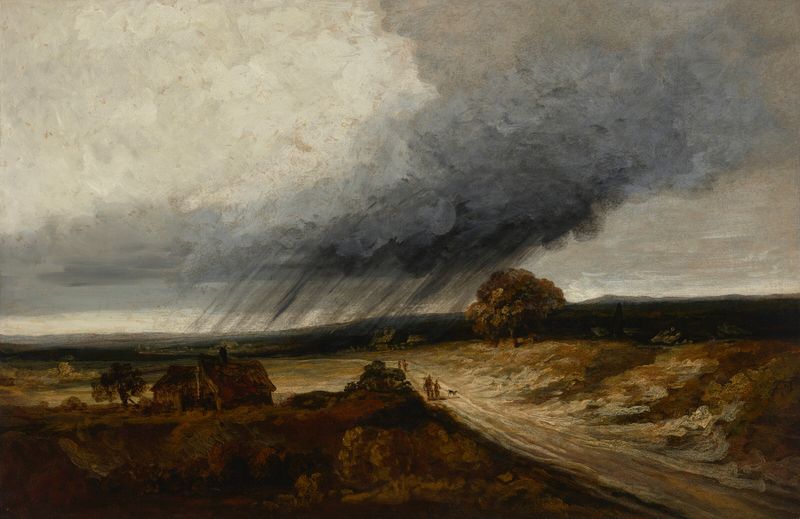
The Approaching Storm
Georges Michel

Landschap met overtrekkende bui
Georges Michel
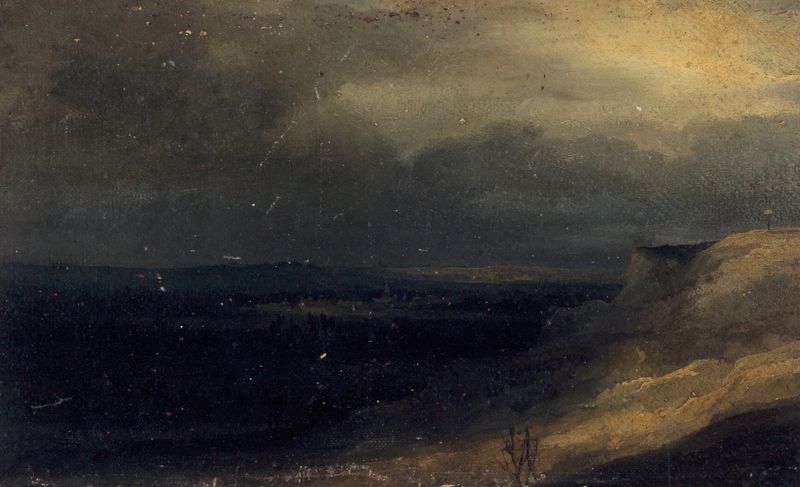
Vue présumée de Montmartre.
Georges Michel

Approaching Storm
Georges Michel
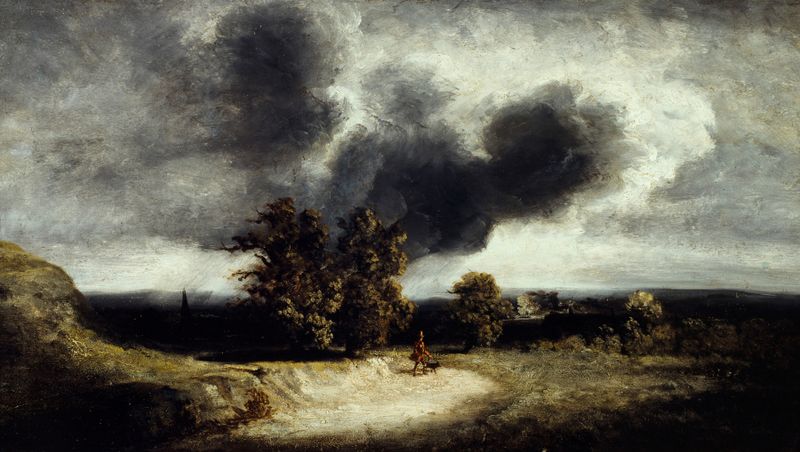
Paysage des environs de Paris.
Georges Michel

Gezicht op de Dome des Invalides uit de Champ de Mars
Georges Michel

Chaumière à la lisière d’un bois
Georges Michel





