Le Maquis de Montmartre vu de la rue Caulaincourt — History & Facts
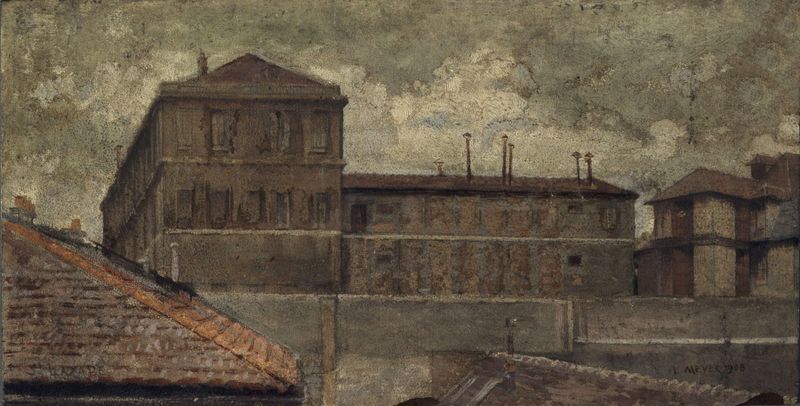
Is this a mirror — or a memory? In Le Maquis de Montmartre vu de la rue Caulaincourt, we are drawn into a world that blurs the lines between reality and illusion, inviting us to ponder what is seen and what is felt. Look to the left, where an intricate play of light filters through the leaves, creating dappled patterns on the cobblestone street. The vibrant greens and earthy browns establish a sense of life and movement, while soft strokes evoke the passage of time. Notice how the houses, their facades bathed in the golden hues of setting sun, seem to lean in toward each other, creating an intimate embrace that envelops the viewer in warmth.
The composition, with its inviting depth and perspective, beckons one to step into the scene and explore the turning corners of Montmartre. Yet within this charm lies a deeper tension. The juxtaposition of light and shadow reflects the duality of the neighborhood's character—an artist's haven filled with vibrancy and creativity, yet haunted by the melancholy of transient moments. The way the street winds away into the distance suggests both a journey and a departure, evoking feelings of nostalgia for what once was.
Small details, like the solitary figure in the distance, hint at the stories and lives intertwined in this lively tapestry, reminding us that every corner holds a secret. In the year 1903, Lazar Meyer crafted this piece while deeply engaged in the vibrant artistic community of Paris. During this period, Montmartre was a crucible of innovation and expression, with artists breaking away from traditional forms to explore more personal narratives. Amidst a backdrop of social and cultural change, Meyer captured the essence of a neighborhood in flux, embodying both the spirit of the time and the intimate memories tied to these streets.