
Le Petit Trianon, Versailles — History & Facts
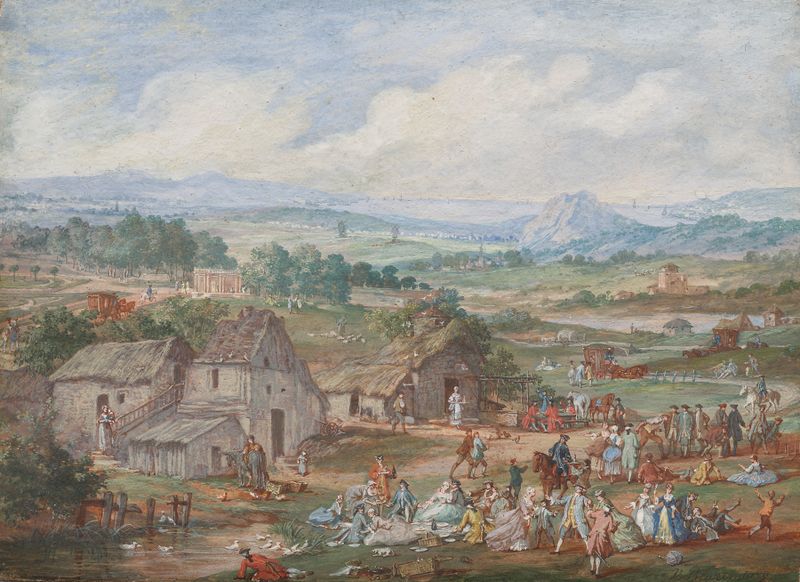
What if beauty was never meant to be finished? In the delicate frames of Louis-Nicolas van Blarenberghe’s work, that question lingers like a whispered secret, steeped in both reverence and trepidation. Look closely at the intricate details of Le Petit Trianon, Versailles. Your gaze should first be drawn to the elegant structure itself, framed by lush greenery and the tranquil reflective waters that mirror its façade. Notice how the soft pastel palette of blues and greens melds seamlessly, evoking a sense of serene harmony, yet shadowed by an undercurrent of melancholy.
The artist’s deft brushwork creates an almost ethereal quality, as if the scene teeters on the edge of reality and dream. Beyond its picturesque charm lies a deeper tension, reflected in the meticulous arrangement of nature and architecture. The graceful lines of the building contrast with the wildness of the surrounding foliage, suggesting a precarious balance between order and chaos. The scene seems to hold its breath, hinting at a fear of the inevitable decay that beauty faces—beautiful yet fleeting, a moment captured yet destined to fade.
Each element, from the symmetry of the architecture to the unpredictable sway of the trees, embodies a dialogue between serenity and the anxiety of impermanence. In the 1700s, van Blarenberghe was immersed in the vibrant artistic milieu of France, where Rococo ideals flourished alongside burgeoning Enlightenment thought. Creating Le Petit Trianon during a period marked by opulence and the shifting sands of societal change, he encapsulated the allure of beauty while acknowledging its fragile nature. The tension within the painting mirrors the complexities of a world poised on the brink of transformation, making it a poignant reflection of both its time and our own.
More Artworks by Louis-Nicolas van Blarenberghe
Browse all →
More Architecture Art
Browse all →
The statue of Liberty
Frédéric Auguste Bartholdi

View of Houses in Delft, Known as ‘The Little Street’
Johannes Vermeer

View of Houses in Delft, Known as ‘The Little Street’
Johannes Vermeer

The Cathedral in Rouen. The portal, Grey Weather
Claude Monet

The yellow house
Vincent van Gogh

The Church in Auvers-sur-Oise, View from the Chevet
Vincent van Gogh