
Le Puy de Dôme de Boisséjour — History & Facts
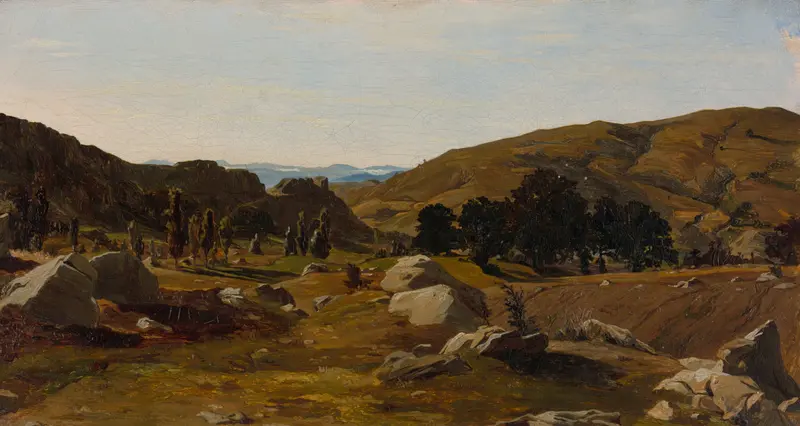
What first draws the eye in Le Puy de Dôme de Boisséjour is the way the land itself seems to rise and breathe beneath a sky washed in the faintest gold. The mountain’s silhouette, blunt and ancient, commands the horizon, but it is the play of earthy reds and ochres in the foreground that holds your gaze. A subtle network of gullies and slopes pulls the viewer inward, as if inviting a slow walk up the ridges and into the heart of the volcanic landscape.
The painter’s brushwork gives the terrain a living texture, each stroke suggesting the roughness of grass, the dryness of stone, and the scars left by water’s passage. The sky, nearly unbroken and pale, presses the drama of the land into sharper relief, making the mountain’s presence feel both solitary and monumental. Works like this, with their close attention to the moods of a specific place, belong to a tradition that flourished in nineteenth-century France, when artists and collectors alike began to value the landscape for its own sake. Painters such as Alexandre Desgoffe often sought out wild or storied sites, capturing not just their forms but their atmosphere, and offering viewers a way to travel in spirit if not in body.
The title’s reference to Puy de Dôme—a volcanic peak in the Auvergne—evokes a region that fascinated both scientists and romantics of the time. Though little is recorded about this particular painting’s origins or journey, its presence in a private collection today is a reminder of how such works continue to carry the memory of place, inviting us to linger over the quiet drama of land and light.
More Artworks by Alexandre Desgoffe

More Landscape Art

The Starry Night
Vincent van Gogh

View of Delft
Johannes Vermeer

Water Lilies
Claude Monet

The Grand Canal, Venice, looking north-west from the Ca' Corner to the Ca' Contarini degli Scrigni, with the campanile of Santa Maria della Carità
Canaletto

Windsor Castle
Canaletto

The Grand Canal looking North-East from the Palazzo Dolfin-Manin to the Rialto Bridge
Canaletto