Le village de Moret-sur-Loing sous la neige — History & Facts
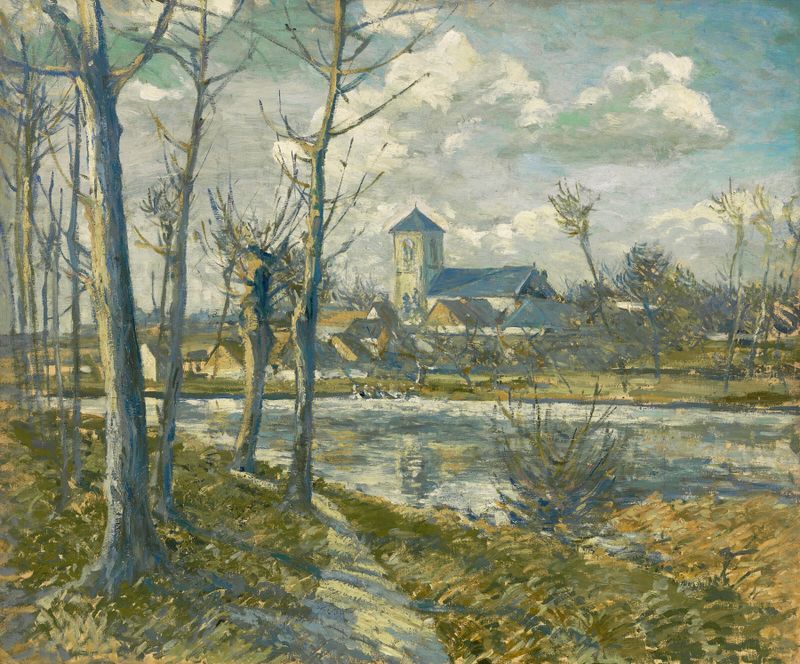
What if beauty was never meant to be finished? In Le village de Moret-sur-Loing sous la neige, the world is captured in a perpetual moment of awakening, its serene landscape inviting the viewer to contemplate the ephemeral nature of life and art. Focus on the gentle drifts of snow blanketing the village, a soft white veil that unifies the composition. The rooftops, dusted delicately, stand in contrast to the deep blues and muted earth tones of the surrounding landscape. Look closely at the bold strokes and geometric forms that suggest movement and life, leading your eye through the quaint village, revealing a harmony between nature and architecture.
The light dances softly across the canvas, highlighting the textures and inviting a sense of calm. Beneath the surface lies a vivid emotional tension, where isolation meets beauty, and the starkness of winter contrasts with the warmth of community. The interplay of light and shadow hints at both tranquility and an underlying restlessness – a reminder of the cycles of life. Each brushstroke captures a fleeting moment, echoing the idea that while beauty is present, it is also transient, urging us to embrace the now. In 1901, while living in Paris, Gleizes was at the forefront of the Cubist movement, exploring new ways to depict reality.
This painting exemplifies his early explorations, as he balanced observation with abstraction, reflecting both his personal journey and the shifting landscapes of modern art. The world was on the cusp of transformation, and through works like this, he sought to capture not just a moment, but the essence of existence itself.