Place animée à Bagnères-de-Bigorre — History & Facts
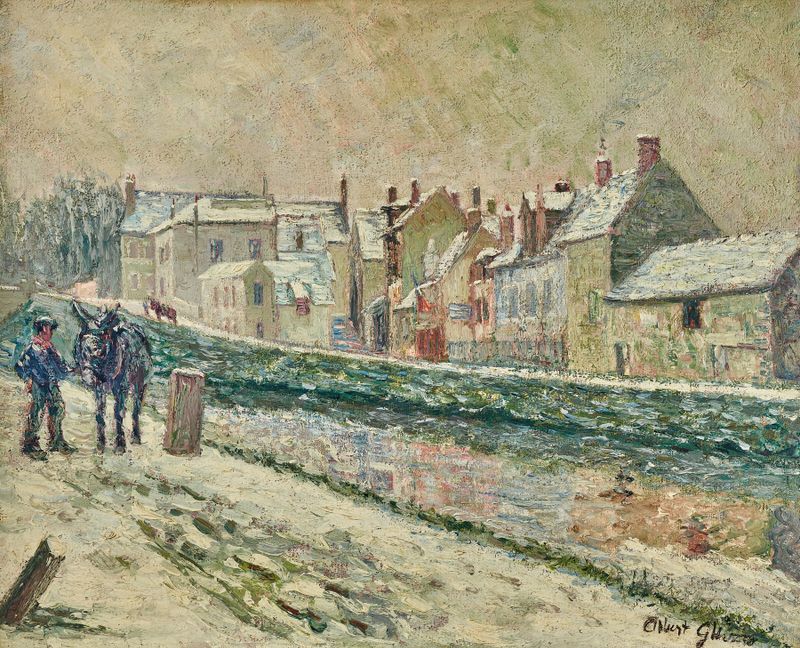
In Place animée à Bagnères-de-Bigorre, the divine intricacies of life are laid bare, illuminating the beauty hidden within everyday moments. This piece invites us to explore the intersection of reality and abstraction, compelling us to decipher the sacred within the mundane. Look to the center, where vibrant shapes converge in a bustling square, capturing the essence of a lively day. The geometric forms almost dance, marked by alternating hues of ochre, blue, and green.
Notice how the angular lines draw your gaze through the composition, creating a rhythmic flow that echoes the heartbeat of the scene. Gleizes employs a restricted palette to evoke harmony, while contrasting planes and fragmented figures suggest a dynamic interplay between humans and their environment. The painting subtly reveals themes of unity and disconnection. The figures, though distinct, merge into the backdrop, suggesting both individuality and collective experience.
The abstract quality of the composition injects a sense of divinity; the viewer is prompted to reflect on the sacredness of shared moments in life, reduced to their elemental forms yet brimming with emotional resonance. Each brushstroke encapsulates a fleeting moment, evoking nostalgia for a time that feels both present and eternal. Created in 1908, this work emerged during a transformative period for the artist, as he deeply engaged with Cubism and sought to incorporate modernity into his interpretations of daily life. Gleizes was stationed in Bagnères-de-Bigorre when he captured this lively scene, reflecting his desire to bridge the gap between traditional representation and emerging avant-garde movements in art.
The world was on the cusp of dramatic change, and his work stands as a testament to the complexity and beauty of existence in that era.