
L’Escalier d’Espagne et la Trinité-des-Monts, le soir — History & Facts
Could a single brushstroke hold eternity? In L’Escalier d’Espagne et la Trinité-des-Monts, le soir, Maurice Denis captures the essence of a moment steeped in both beauty and sorrow, evoking a profound sense of longing that transcends time. Look to the left at the soft, muted tones of the evening sky, where a delicate lavender fades into dusky blues, suggesting the approach of dusk. The central staircase, a winding path, draws the eye downward, while the silhouette of the Trinité-des-Monts stands resolute in the background. The brushwork is both fluid and deliberate, allowing the viewer to feel the gentle movement of the scene as light dances across the steps, creating a harmonious blend of color and form that invites contemplation. In the subtle interplay between the warm hues of the buildings and the cool shadows cast by the encroaching night, one can sense the tension between light and darkness—an echo of grief woven into the fabric of the painting.
The figures, almost ghostly in their presence, appear lost in thought, as if the weight of their memories lingers in the air. The staircase, a metaphor for ascent and descent, symbolizes the duality of experience, reminding us that beauty often coexists with sorrow. Denis painted this piece in 1928 amidst a time of introspection in his career, following the tumultuous years of World War I. Residing in Paris, he sought to explore new avenues in symbolism and color, moving away from the more traditional approaches of earlier movements.
As the world around him transformed, so too did his art, reflecting both personal and universal truths that resonate within the simplicity and complexity of this evocative scene.
More Artworks by Maurice Denis
Browse all →
La plage rouge
Maurice Denis
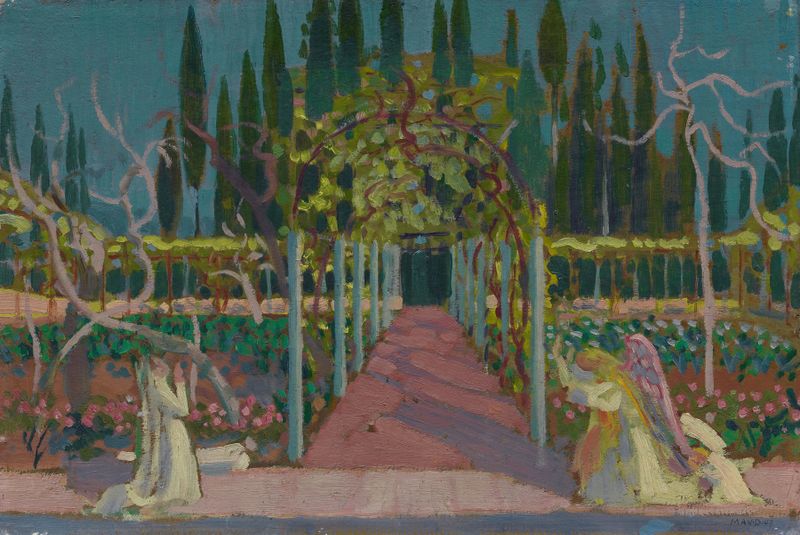
Annunciation
Maurice Denis
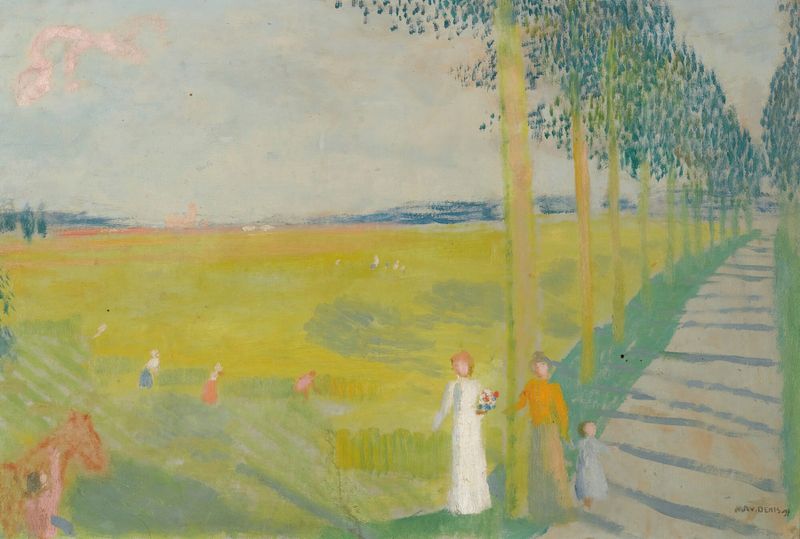
Paysage De Campagne
Maurice Denis
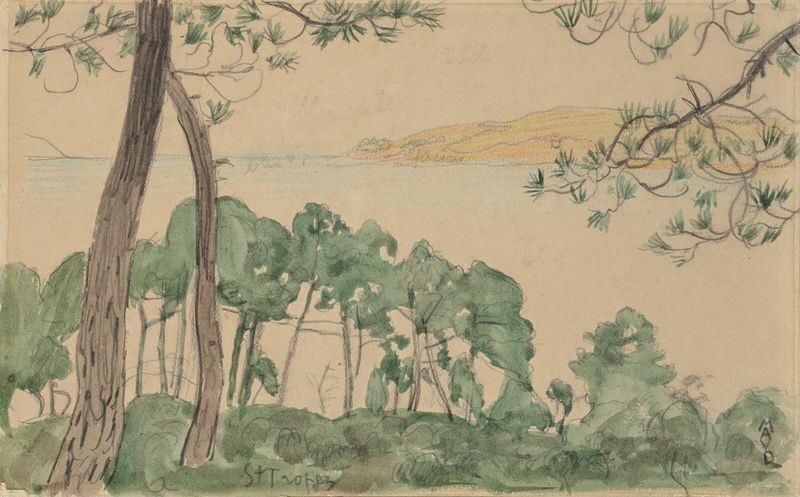
Saint-Tropez
Maurice Denis

Étretat
Maurice Denis

Blessing of a Yacht on the Belon River
Maurice Denis

Vue du Colisée
Maurice Denis

Forum, l’Arc de Constantin
Maurice Denis

La Piazzetta, Venise
Maurice Denis

Jardin sous la neige
Maurice Denis





