Loading Hay — History & Facts
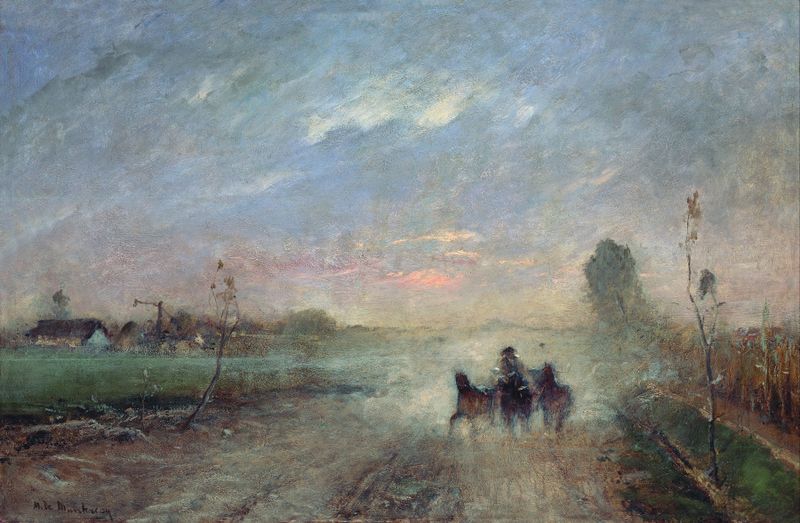
Can beauty exist without sorrow? In Loading Hay, Mihály Munkácsy captures a moment steeped in hope, revealing the intertwining nature of labor and aspiration. Look to the foreground, where a peasant, bent with the weight of his task, lifts a bundle of hay, muscles taut and brow glistening. The rich, earthy tones of ochre and green create a landscape that flourishes under the golden light, illuminating the laborer's toil against the soft blue of the sky. Notice how the warm hues envelop the scene, suggesting the promise of harvest and the cyclical nature of life, while shadows subtly hint at fatigue, infusing the composition with emotional depth. The juxtaposition of physical exertion and the promise of reward speaks to the resilience of the human spirit.
The laborer’s posture embodies a tension between weariness and determination, inviting viewers to reflect on the sacrifice inherent in pursuit of sustenance. The surrounding scenery further enhances this contrast; idyllic fields of hay symbolize abundance, yet the solitary figure, immersed in his work, reminds us of isolation and the burdens borne in silence. Munkácsy painted Loading Hay around 1886-87 during a transformative period for art in Europe, where realism began to flourish, depicting everyday life with unflinching honesty. At this time, he was living in Paris, where he was influenced by the work of contemporaries who prioritized authenticity in their representations of the working class.
This context underscores the painting's celebration of labor, capturing a universal narrative of hope amid hardship.