Lost: Souvenir of Auvergne — History & Facts
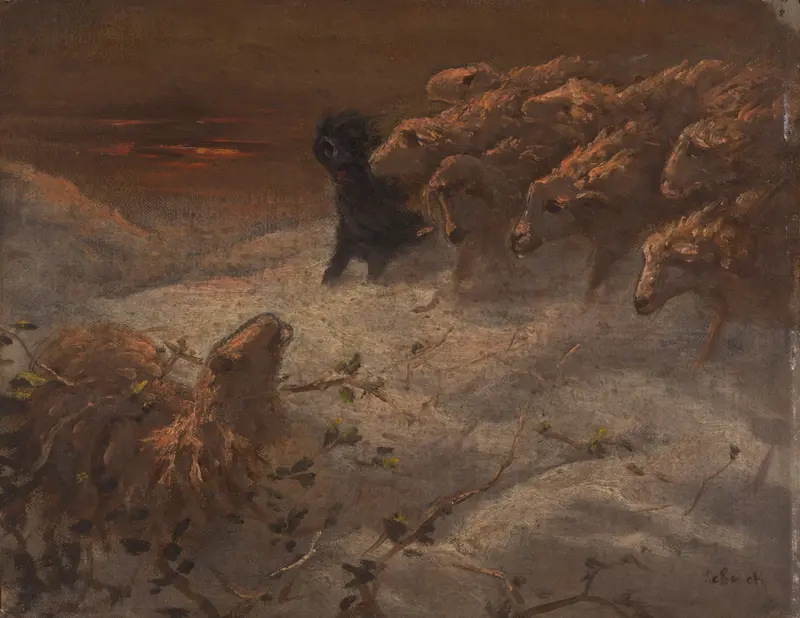
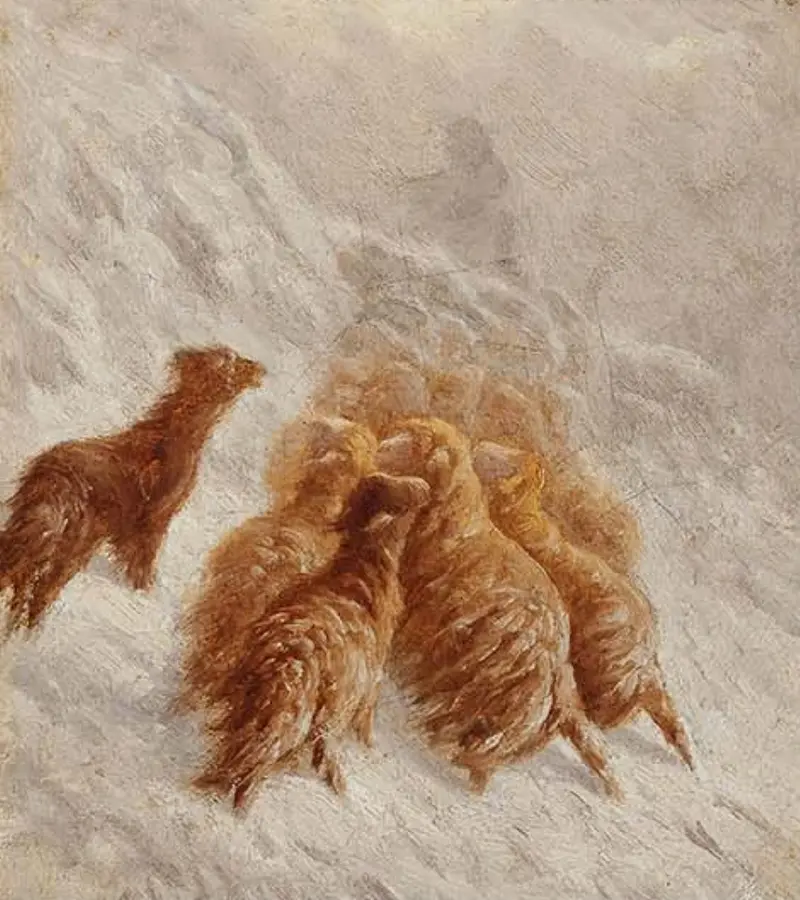
A swirl of panic and protection surges through the heart of this scene, where a flock of sheep huddles tightly against a blinding storm, their wool heavy with snow and fear. The eye is drawn first to the anxious faces of the animals, some bleating, others wide-eyed, all pressed together in a desperate cluster. Two vigilant dogs, their fur bristling, stand guard at the flock’s edge—one mid-bark, the other straining forward, embodying the tension between duty and dread.
In the distance, barely visible through the whiteness, a solitary cross rises from the snow, a silent marker of loss or memory, its presence both haunting and protective. The composition channels the viewer’s gaze from the chaotic foreground to that spectral cross, inviting reflection on vulnerability and guardianship. Painted in 1873, Lost: Souvenir of Auvergne by August Friedrich Schenck belongs to a tradition of 19th-century animal painting that flourished in France and Germany, where artists turned rural hardship into grand, emotional narratives. Such works often found their way into the homes of urbanites nostalgic for a vanishing countryside, or into salons where they stood as meditations on nature’s indifference and the bonds between man, beast, and land.
The Metropolitan Museum of Art’s inclusion of this painting, as documented by its open-access project, hints at the enduring power of these rural dramas to move viewers across centuries. History has kept few traces of this particular canvas’s journey, but the storm it captures still rages in the eyes of its flock—inviting us to linger, to search for shelter, and to wonder what lies just beyond the drifting snow.