
Maaltijd van Esther, Ahasverus en Haman — History & Facts
What if beauty was never meant to be finished? The fleeting moments of truth often linger just beyond our grasp, captured only in fragments that echo through time. In the chiaroscuro of Maaltijd van Esther, Ahasverus en Haman, a narrative unfolds, revealing the dramatic interplay of power and peril. Look to the center where Esther, radiant yet anxious, occupies a pivotal space at the banquet table. The artist deftly uses light to illuminate her face, casting a soft glow that contrasts starkly with the shadows surrounding King Ahasverus and Haman.
Notice how the rich, deep colors — crimson, gold, and deep green — evoke a sense of opulence, while simultaneously hinting at underlying tension in this courtly setting. The composition draws the eye toward the lavish feast, yet the expressions of the figures suggest that not all is well, leaving an unsettling air. Peering closer, one discovers the intricate details — the careful placement of utensils, the expressions of suspicion and dread. Haman’s furrowed brow speaks volumes, suggesting he is oblivious to the fate that looms over him.
The juxtaposition of lavish abundance against the backdrop of betrayal infuses the scene with dramatic irony, inviting viewers to reflect on the thin veil between celebration and calamity. It nudges us to consider the deeper truths of loyalty, sacrifice, and the weight of choices made in the shadows of power. In 1526, the artist, known as Monogrammist DDC, painted this compelling piece during the northern Renaissance, a time of burgeoning artistic exploration. Positioned in a world where court intrigue and moral dilemmas were rife, the artist encapsulated a moment of historical significance that reflects the tensions of authority and humanity.
This work stands as a testament to the complex narratives that art can convey, inviting contemplation on the enduring nature of truth and consequence.
More Artworks by Monogrammist DDC
Browse all →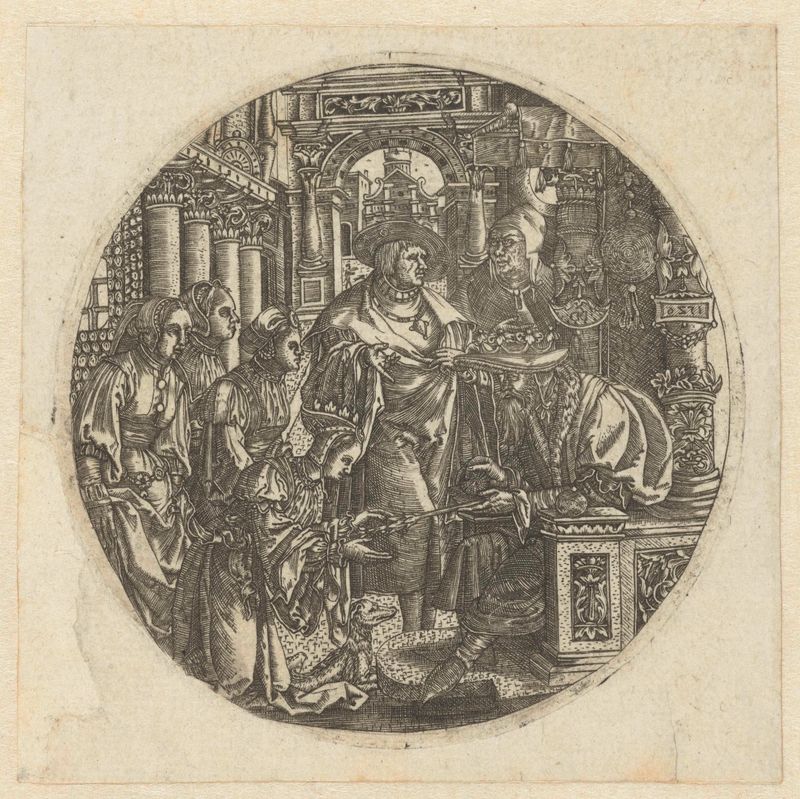
More Historical Art
Browse all →
The Night Watch Militia Company of District II under the Command of Captain Frans Banninck Cocq
Rembrandt van Rijn

Lincoln Memorial
Henry Bacon

The Third of May 1808
Francisco de Goya

Isaac and Rebecca, Known as ‘The Jewish Bride’
Rembrandt van Rijn

The Charge of the Mamelukes (1814)
Francisco de Goya

De vier ruiters van de apocalyps
Albrecht Dürer