Marine landscape — History & Facts
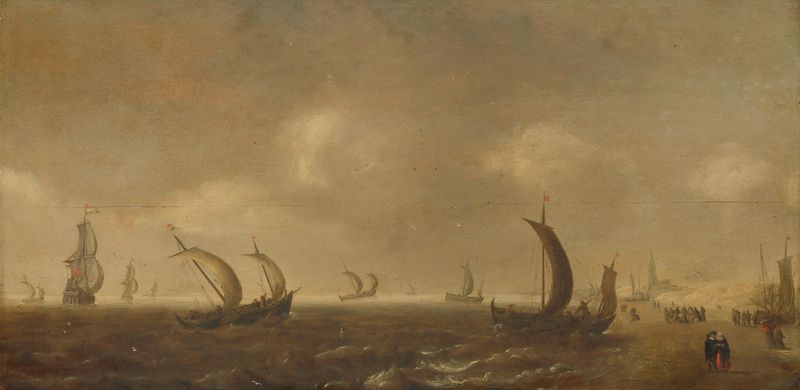
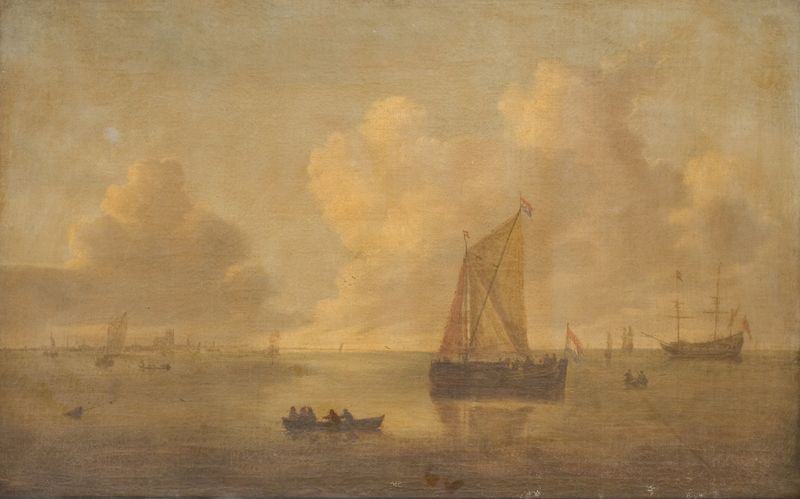
Did the painter know this moment would outlive them? In Marine Landscape, the canvas resonates with a stillness that speaks to the faith in nature’s endurance, a testament to the tranquility that beckons from beyond the horizon. Focus on the gentle undulation of waves, each brushstroke capturing a sense of movement that evokes both calm and awe. Look to the left, where the sun begins its descent, casting a golden hue on the water's surface, illuminating the scene with a celestial glow. Notice how the sky, a mixture of soft blues and warm oranges, reflects the serenity of the evening, while the distant ships, mere silhouettes, hint at a world teeming with life yet anchored in peaceful silence. The contrast between the expansive sky and the small vessels in the foreground emphasizes the duality of man's vulnerability against nature’s vastness.
Each ripple in the water mirrors the fleeting passage of time, while the faint horizon line invites contemplation about what lies beyond. Here, faith is not just in the scene but in the artist's brush; a belief that beauty and peace can be captured, cherished, and shared across generations. Willem van Diest painted this landscape during the early 17th century, a period marked by the flourishing of Dutch marine art. Working in the Netherlands, he was influenced by his predecessors and contemporaries, reflecting the era's growing interest in maritime themes as a way to explore both national pride and human connection to the natural world.