Miasto fabryczne — History & Facts
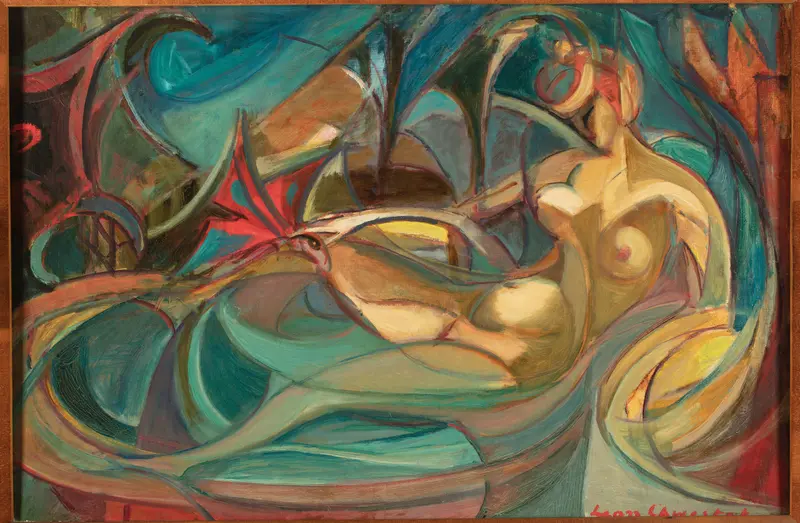
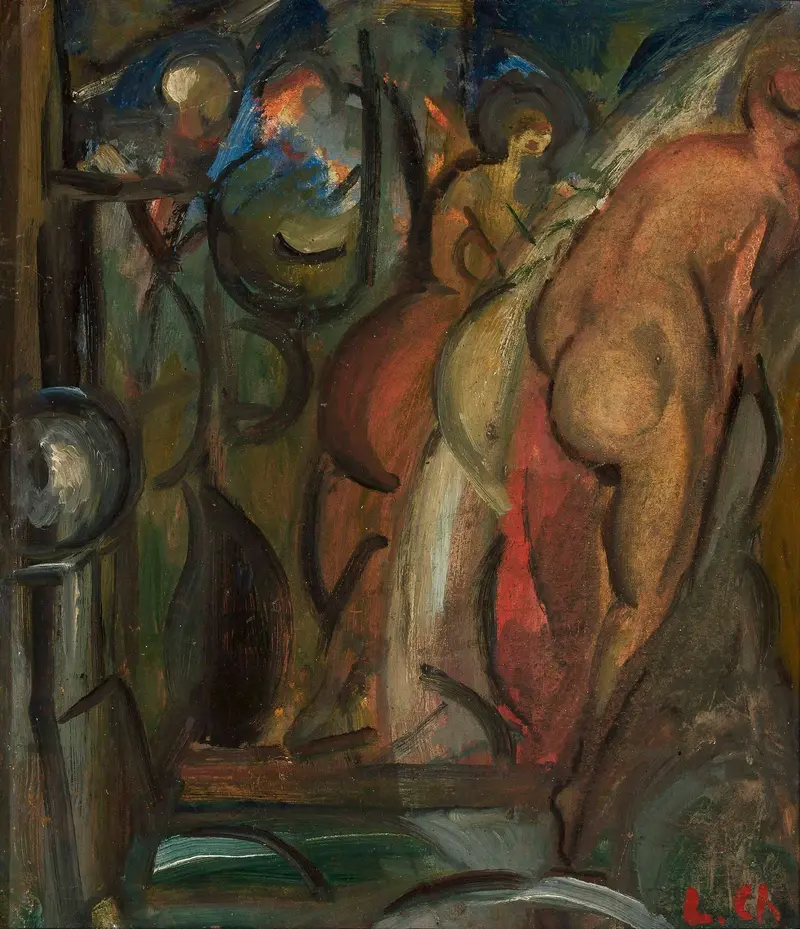
The eye is caught first by a city that seems to surge upward and outward at once, its forms fractured and multiplied until the whole scene hums with restless energy. In Miasto fabryczne, Leon Chwistek turns the city into a living engine, its towers and domes pressed together in a dense, almost feverish tangle of lines. Trains snake across the foreground, their tracks looping and intersecting like veins, while smokestacks and girders shoot skyward, dissolving into a swirl of yellow and blue.
The palette is industrial but never cold—there are flashes of ochre and teal, and the brushwork pulses with movement, as if the city itself is caught mid-transformation. The whole composition feels on the verge of bursting, a metropolis seen through the lens of invention and upheaval. Painted in 1920, this work belongs to a moment when artists across Europe were reimagining the city as both promise and threat, a place of dizzying speed and modernity. Leon Chwistek was part of the Polish avant-garde, and his vision here shares the fractured dynamism of Italian Futurism and the analytic eye of Cubism.
In the wake of World War I, the factory city was both a symbol of progress and a source of anxiety—its new forms reflected in the jagged architecture and relentless rhythm of the painting. Now housed in the National Museum in Warsaw, Miasto fabryczne stands as a vivid record of a world hurtling into the future, inviting viewers to lose themselves in its labyrinth of steel and possibility.