Mount Giewont — History & Facts
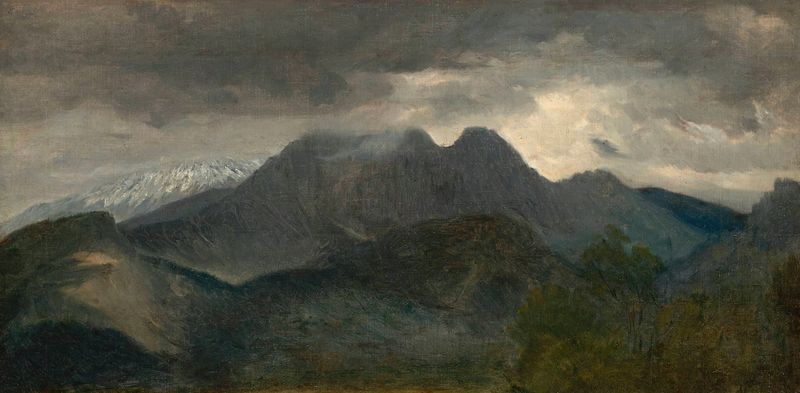
In a world where whispers of mortality linger, every brushstroke captures the ephemeral nature of existence, inviting us to reflect on our own transience. Look to the foreground where the rugged contours of Mount Giewont emerge, a sentinel of nature poised against a vast sky. The interplay of light and shadow creates a dramatic tension, emphasizing the mountain’s formidable presence while inviting the viewer’s gaze upward. The subdued palette of greens and browns contrasts with the ethereal blues above, highlighting both the grandeur of the natural world and the solitude that accompanies it. Hidden within this landscape are the echoes of human consciousness.
The mountain stands as a metaphor for permanence, while the shifting clouds above evoke the fleeting moments of life. This juxtaposition draws us into an introspective journey, reminding us that beauty is often intertwined with the inevitability of decay. The surprising delicacy of the brushwork in the sky contrasts with the rugged solidity of the earth, symbolizing the tension between resilience and fragility. Aleksander Kotsis created this piece in 1870, amidst the heart of Poland’s romantic landscape movement.
During this period, the artist sought to capture the essence of nature while reflecting his own experiences in a rapidly changing world. Kotsis’s dedication to portraying the majestic landscapes of his homeland coincided with a broader European fascination with the sublime, underscoring his role in the evolution of Romanticism in art.