Mountain Road with Travelers — History & Facts
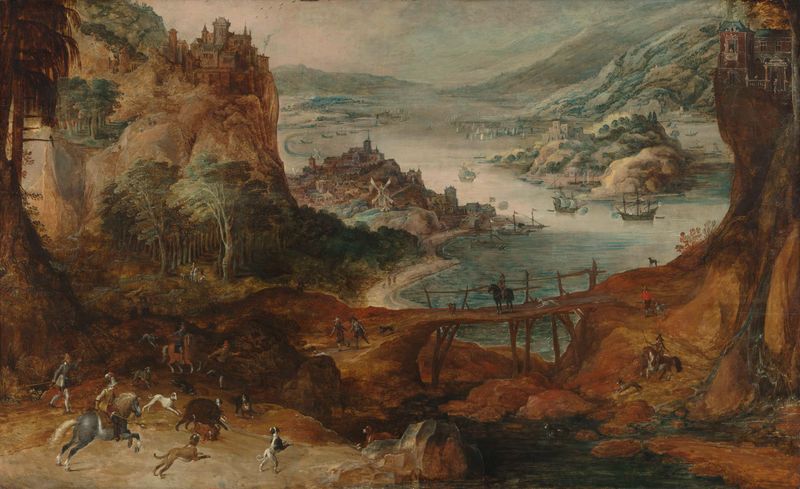
Where does light end, and longing begin? The interplay of nature and humanity in a landscape often invites a deeper reflection on our place within it. Look to the left at the winding mountain road, where travelers are just visible, creating a sense of movement and purpose. The sky, an expansive canvas of vivid blues and soft whites, draws the eye upward, while the rugged peaks loom majestically in the background, their textures rendered with striking detail. Notice how the light cascades down the mountainside, illuminating patches of green and earth, a divine glow that seems to bless the journey ahead. In the foreground, the juxtaposition of the tranquil landscape and the human figures suggests a yearning for connection with something greater than themselves.
The travelers, though dwarfed by the vastness of the scene, embody a shared aspiration. Each subtle gesture—the lean of a shoulder, the tilt of a head—implies a silent communication, as if they seek not only the destination but also the divine essence of the journey itself. The interplay of light and shadow throughout the work speaks to the contrasts of existence: between solitude and community, ambition and surrender. Joos de Momper II painted Mountain Road with Travelers around 1615, during a time when Northern European art was increasingly exploring landscapes infused with spiritual and emotional depth.
Working amidst the rise of the Dutch Golden Age, he infused his works with meticulous detail and a profound reverence for nature, reflecting both personal introspection and societal shifts in perception of the natural world.