New England Coastline — History & Facts
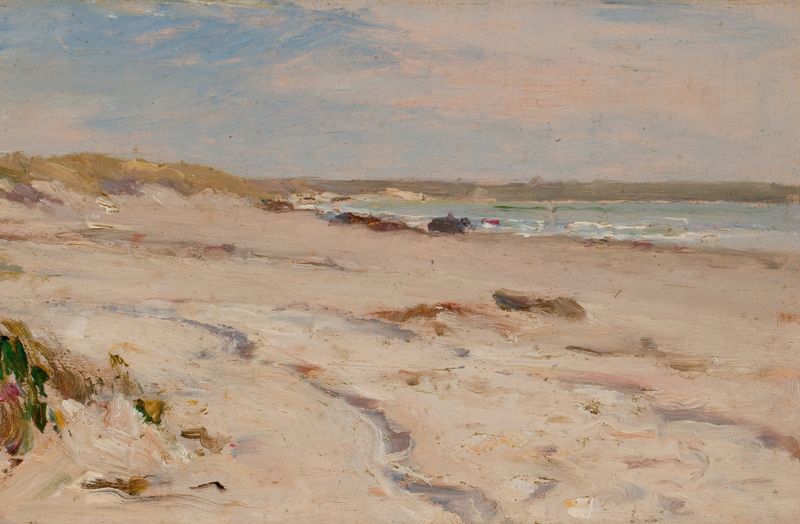
What if beauty was never meant to be finished? An endless horizon stretches, merging seamlessly with the sky, inviting the viewer to contemplate the vastness of both the landscape and their own thoughts. Look to the left, where rocky outcrops cradle the crashing waves, each brushstroke capturing the relentless energy of the sea. The artist’s deft use of a muted palette imbues the scene with a sense of tranquility, while the soft greys and blues evoke the perpetual dance of water and sky. Notice how Vinton’s careful layering creates depth, drawing the eye towards the distant shoreline, where the land meets the misty horizon. In this composition, the interplay between the turbulent ocean and the calm sky evokes a deep emotional tension — a reminder of nature's duality.
The void left by the unpainted areas stirs a sense of longing, suggesting that some parts of beauty remain untouched and elusive. Each wave's froth captures fleeting moments, while the stillness above hints at serenity interspersed with chaos, prompting us to reflect on our own existence between these states. Frederick Porter Vinton painted this piece around 1885, during a period of burgeoning interest in American Impressionism. Living in New England, he was deeply influenced by the coastal landscapes around him, which allowed him to experiment with light and atmosphere.
As artists began to break away from tradition, Vinton contributed to this evolving movement, capturing the essence of place and time through his evocative brushwork.