
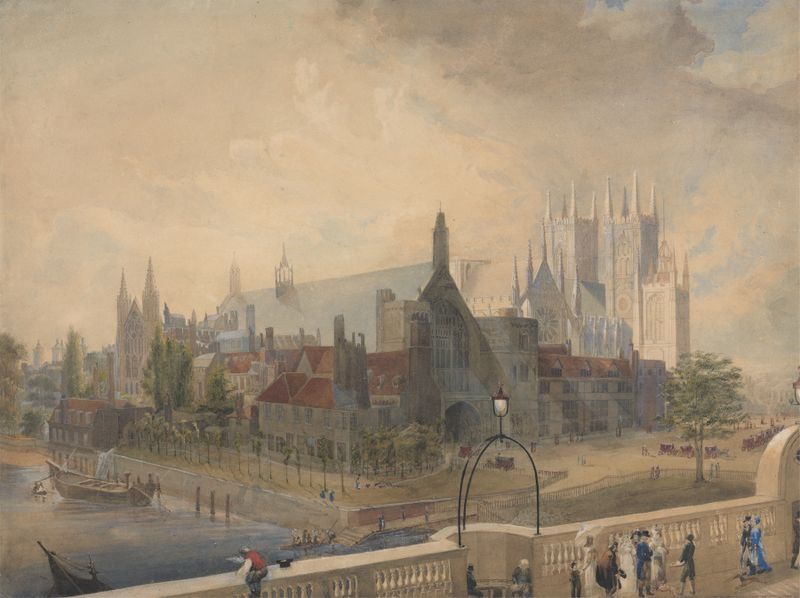
Northeast view of Westminster Abbey — History & Facts
What secret hides in the quiet of the canvas? In a world bustling with life, the stillness of this view invites contemplation on the passage of time and the subtle decay that accompanies it. Focus on the intricate details of the stone façade, carved with centuries of history. Look closely at the gothic arches—each one a testament to craftsmanship now softened by time. The muted palette draws attention to the weathered textures, suggesting the wear of many seasons, while the careful interplay of light and shadow casts an ethereal glow, illuminating both grandeur and fragility. Beneath the surface lies a poignant tension between beauty and decay.
The delicate ivy creeping along the edges signifies nature’s reclamation, whispering of inevitable change. In this serene moment, the viewer is reminded of the transience of human achievement; even the most magnificent structures cannot escape the embrace of time. The stillness becomes a meditation on both the enduring spirit of creation and the quiet decay that shadows it. John Gendall painted this iconic view of Westminster Abbey in a period marked by a resurgence of interest in Gothic architecture and a focus on historical preservation.
Working in the early 19th century, he was part of a larger movement seeking to capture the essence of England's architectural heritage. At that time, the nation was reflecting on its past, navigating the tensions of industrial progress while yearning for the stability of its historical roots.
More Artworks by John Gendall
Browse all →
More Architecture Art
Browse all →
The statue of Liberty
Frédéric Auguste Bartholdi

View of Houses in Delft, Known as ‘The Little Street’
Johannes Vermeer

View of Houses in Delft, Known as ‘The Little Street’
Johannes Vermeer

The Cathedral in Rouen. The portal, Grey Weather
Claude Monet

The yellow house
Vincent van Gogh

The Church in Auvers-sur-Oise, View from the Chevet
Vincent van Gogh