Paysage d’été — History & Facts
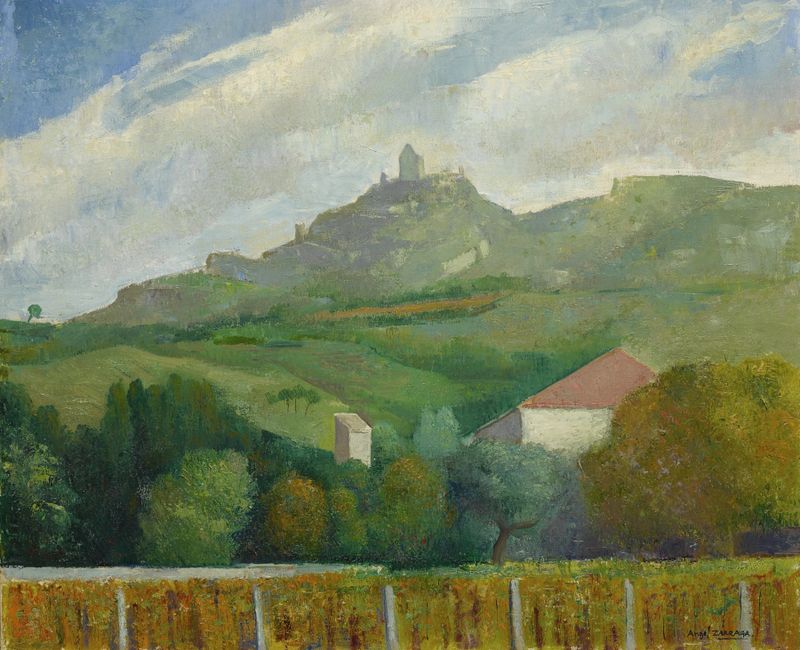
What if beauty was never meant to be finished? In Paysage d’été, Ángel Zárraga presents an eternal landscape, where each brushstroke evokes an unquenchable yearning for nature’s fleeting splendor. Look to the left at the rolling hills, their verdant greens whispering secrets of summer’s warmth. The horizon is alive with a vibrant blue sky that stretches infinitely, punctuated by soft, billowing clouds. Notice how the sunlight bathes the scene in a golden glow, creating an inviting atmosphere that beckons you closer.
Zárraga's delicate technique blends impressionism with a personal touch, the colors harmonizing to evoke a sense of peace and nostalgia. Yet, beneath this idyllic facade, tensions simmer—a blend of exuberance and melancholy. The distant mountains, though majestic, appear shrouded in a slight haze, suggesting the elusive nature of happiness and the longing for unreachable heights. The interplay of light and shadow deepens the emotional gravity, hinting at the transient nature of summer and, by extension, life itself.
Each detail is a reminder of beauty’s impermanence, igniting a profound sense of searching within the viewer. Created in Mexico in 1921, during a time when the artist was exploring new forms of expression, Zárraga's Paysage d’été reflects the post-revolutionary context of artistic renewal. It captures a moment in which he sought to forge a distinct identity, merging European influences with his Mexican heritage. In this work, his brush not only paints a landscape but also articulates a longing that resonates beyond the canvas, embodying a universal quest for beauty.