Pines — History & Facts
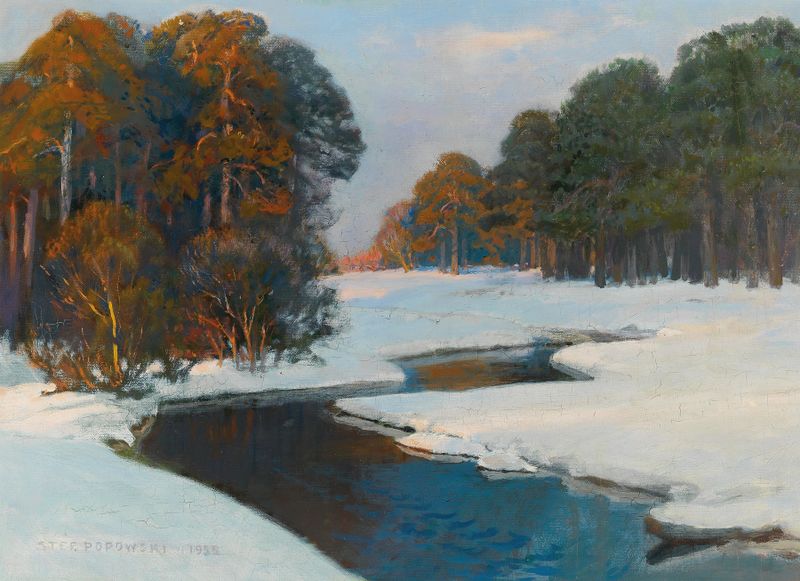
Did the painter know this moment would outlive them? In Pines, a haunting stillness envelopes the viewer, drawing forth an insatiable curiosity about the nature of existence and the passage of time. Look to the left, where tall, somber trees stretch upwards, their slender trunks disappearing into a canopy of muted greens. The brushstrokes reveal a gentle interplay of light and shadow, emphasizing the delicate texture of the leaves that seem to whisper secrets of solitude. Notice how the horizon fades beyond the trees, creating an expanse that feels both expansive and confining—a metaphor for the human condition.
The palette embodies a melancholic beauty that invites contemplation, as if the very air is thick with unspoken thoughts. Within this serene landscape lies a profound sense of emptiness, as the trees stand sentinel over a space that feels both sacred and desolate. The careful arrangement of negative space enhances the tension, suggesting that what is absent—the rustle of life, the laughter of company—masks a deeper yearning within the observer. The pines, though majestic, evoke a solitude that resonates with the complexities of being alone in a vast world. In the year 1900, Stefan Popowski painted this evocative scene during a period marked by the burgeoning modernist movement, which sought to redefine artistic expression.
Living in France, he was influenced by the shifts in society and the environment, capturing the essence of nature while reflecting on personal isolation amid rapid change. This artwork stands not merely as a representation of trees, but as a poignant commentary on existence itself, echoing the sentiments of a world in transition.