Portrait of a young girl — History & Facts
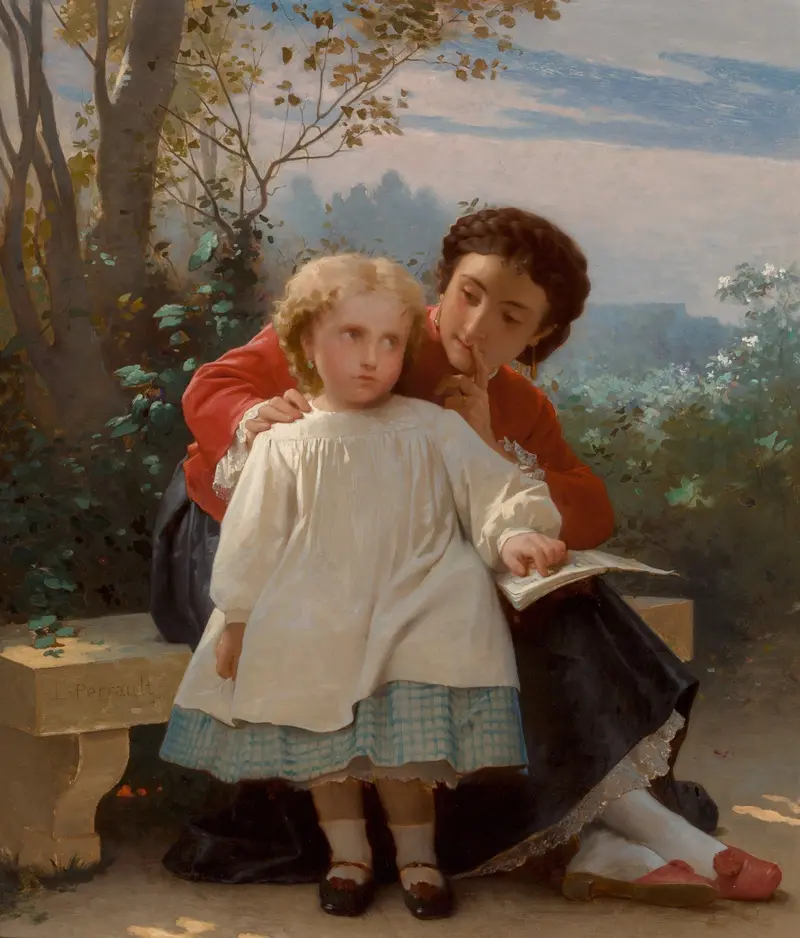
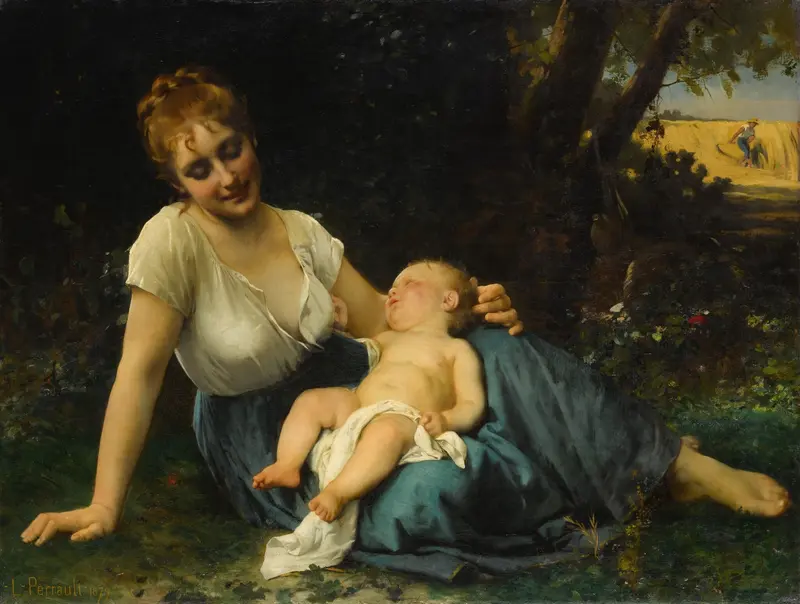
What holds the viewer here is the quiet gravity in the young girl's gaze—steady, almost questioning, as if she is weighing the world from her small vantage. The painter leads us first to her face, softly illuminated so that the blush of her cheeks and the glint in her eyes emerge from the shadowed background. Her hands are folded with a gentle awkwardness, fingers entwined in a gesture that betrays both innocence and a touch of self-consciousness.
The careful rendering of her costume—embroidered apron, crisp white blouse, bright beads and hoop earrings—signals a pride in her humble attire, while the earthy palette anchors her firmly in her surroundings. Every detail, from the delicate lace at her cuffs to the faint green shoots at her feet, seems chosen to invite a second, closer look. Painted in 1874 by Léon-Jean-Basile Perrault, this portrait belongs to a moment in nineteenth-century France when artists were captivated by the dignity of rural childhood. Works like this were often commissioned by a rising middle class, eager to celebrate innocence and virtue in a rapidly changing society.
Perrault, known for his sentimental realism, was part of a generation that found poetry in the everyday, favoring scenes of ordinary people over the grand historical narratives of earlier decades. Though little is recorded about this specific painting beyond its presence in the Sotheby's collection, it stands as a testament to the era's fascination with childhood as both a subject and a symbol. The girl's steady gaze still asks the viewer to linger, searching for the story behind her quiet poise.