Returning from the Hay Harvest — History & Facts
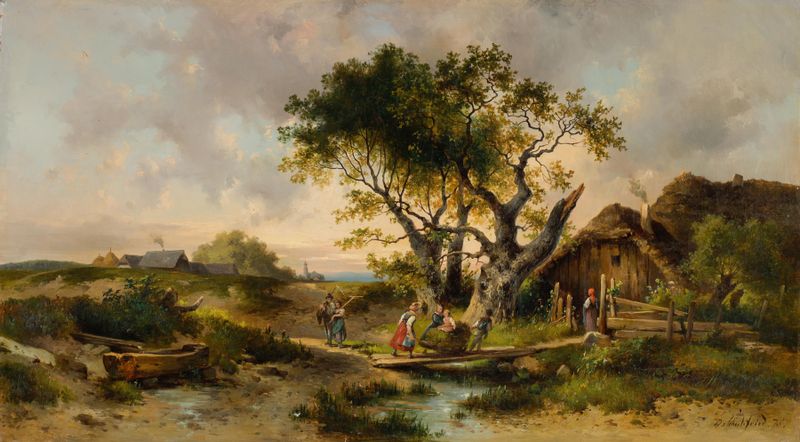
In the delicate interplay of light and shadow, an illusion emerges, inviting us to explore the layers of reality within this work. Focus on the vibrant greens and golds that dance across the canvas, highlighting the figures that meld seamlessly with the landscape. Look to the left, where workers, their labor evident, emerge from the fields, the scythes cradled in their arms like worn trophies. Notice the way the sunlight spills over their forms, illuminating their faces and casting long shadows that stretch toward the horizon, blending their existence with the land.
Schuhfried’s brushwork captures a fleeting moment, where labor meets leisure—a pause before the day’s toil gives way to evening's embrace. As you delve deeper into the composition, consider the emotional tensions at play: the harmony between man and nature, the weariness of work counterbalanced by the tranquility of homeward journey. The juxtaposition of figures and landscape portrays a world where the laborer is both an integral part of the earth and an outsider looking in. The warmth of the colors evokes a sense of nostalgia, while the subtle tension suggests an unspoken longing for rest and reflection amid the relentless rhythm of life. Created in 1874, this piece reflects Dominik Schuhfried's commitment to capturing the essence of rural life during a time of significant change in Europe.
As industrialization began to reshape the landscape, the artist sought to immortalize the simplicity and beauty of agricultural labor. Painted in Austria, this work embodies a moment of stillness, a connection to the past, and a subtle commentary on the transient nature of existence amid an evolving world.