
Rue de Rivoli and Pavillon Marsan — History & Facts
In the stillness of a moment captured on canvas, there lies an awakening, an invitation to see beyond the surface and explore the pulse of life beneath. Look to the left at the striking architecture, where the angular lines of the Pavillon Marsan rise with an elegant grace against the soft backdrop of the sky. Notice how the muted palette of blues and grays contrasts with subtle bursts of sunlight, painting shadows that dance along the cobblestone path. The composition draws your eye through the scene, leading you toward the distant figures milling about, their presence both fleeting and significant, as if time itself has paused. Hidden within the quiet elegance of this urban tableau are the themes of transition and connectivity.
The juxtaposition of the solid, unyielding structure against the ephemeral movement of the people suggests a dialogue between permanence and transience. Each figure carries their own story, a reminder of the countless lives intersecting in this vibrant tableau of city life. The viewer is left to ponder the relationships forged in the anonymity of the streets. Created in an undefined moment in time, the artist worked during a period of great change in France, likely influenced by the Romantic movement that celebrated individual experience and emotion.
The work embodies a meticulous attention to architectural detail, characteristic of his style, while also hinting at the underlying social dynamics of a bustling Paris. In this work, one can sense the artist's desire to document not just a place, but the very essence of life itself.
More Artworks by François Etienne Villeret
Browse all →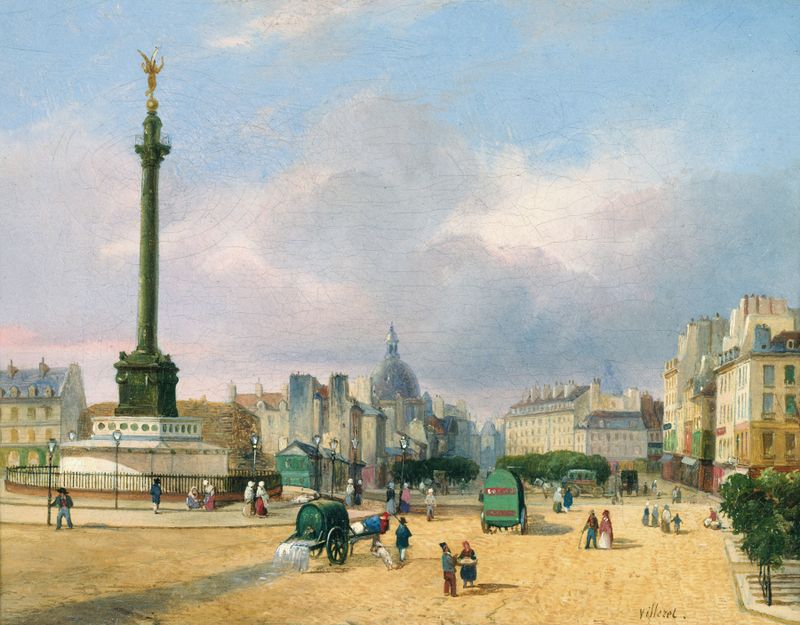
More Architecture Art
Browse all →
The statue of Liberty
Frédéric Auguste Bartholdi

View of Houses in Delft, Known as ‘The Little Street’
Johannes Vermeer

View of Houses in Delft, Known as ‘The Little Street’
Johannes Vermeer

The Cathedral in Rouen. The portal, Grey Weather
Claude Monet

The yellow house
Vincent van Gogh

The Church in Auvers-sur-Oise, View from the Chevet
Vincent van Gogh