
Rue À St. Lunaire — History & Facts
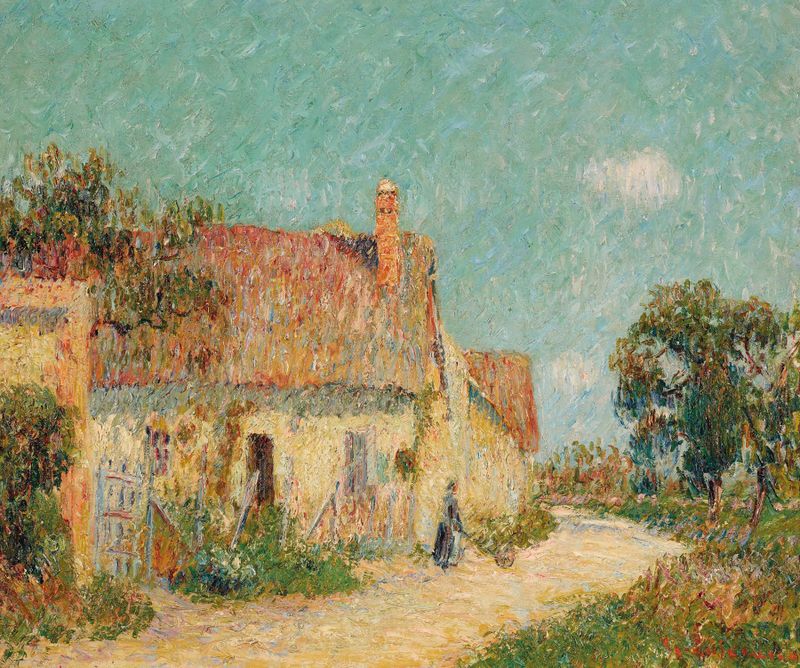
When did color learn to lie? The vibrant palette often tells a story of whimsy, yet it can deceive, masking deeper truths beneath its surface. Focus on the bold strokes that form the winding path in the foreground, pulling your gaze into the scene. Notice how the emerald greens and cerulean blues blend seamlessly, painting a tranquil yet inviting atmosphere. The balance between the lively hues and the soft, impressionistic touch draws you into a world both familiar and dreamlike, inviting contemplation on the nature of reality. Beneath the surface, the interplay of light and shadow hints at a deeper narrative.
The dappled sunlight, filtered through the trees, casts playful patterns on the cobblestones, suggesting fleeting moments of joy intertwined with the passage of time. The road’s gentle curve may symbolize life’s unpredictable journey, where beauty and uncertainty converge, revealing the complexities behind what we see. In 1904, Loiseau painted this work during a period marked by the rise of Impressionism and the quest for new expressions in color and form. Living in France, he was inspired by the natural landscape around him, yet his explorations also coincided with a wider artistic shift towards capturing the ephemeral.
As he embraced vibrant colors, Loiseau sought to convey both the aesthetic beauty of nature and the emotions it evokes, marking a significant evolution in his artistic journey.
More Artworks by Gustave Loiseau
Browse all →
Rue de village en Normandie
Gustave Loiseau
Chaumière en Normandie
Gustave Loiseau

Paysage d’Hiver à Chaponval
Gustave Loiseau
Tournant de rivière, L’Eure
Gustave Loiseau

Pont Marie, Paris
Gustave Loiseau

Le Bras De Mer
Gustave Loiseau

Le Pont Suspendu À Triel
Gustave Loiseau

Bord de la rivière
Gustave Loiseau
Le Quai Duquesne à Dieppe
Gustave Loiseau

Rocher la Teignouse, Cap Fréhel
Gustave Loiseau





