
Salisbury — History & Facts
Could beauty survive in a century of chaos? Salisbury invites us to ponder this question through its interplay of light and shadow, a delicate balance that captures both tranquility and tumult. Look to the left where the majestic spire of the cathedral reaches skyward, etched against the pale blue sky. Ginner employs a muted palette that lends an ethereal quality to the scene, allowing the shadows to deepen the architectural forms. Notice how the trees in the foreground frame the structure, their dark, twisting branches creating a stark contrast to the serenity of the building behind.
This deliberate composition draws your eye up, emphasizing the towering presence of the cathedral nestled among the natural world. As you explore further, subtle tensions emerge. The delicate shadows cast by the trees seem to whisper of unseen forces, suggesting an underlying struggle between nature and human ingenuity. The quietude of the scene, despite the evident architecture, evokes a sense of isolation, as if the beauty of the moment exists in defiance of an increasingly chaotic world.
Each stroke of paint hints at a narrative—one of resilience in the face of uncertainty. In 1935, Ginner painted this work during a period marked by economic instability and looming global conflict. Living in England, he was part of a movement that sought to capture the essence of British landscapes through a modern lens. His perspective in Salisbury reflects not only personal introspection but also the broader artistic response to a world on the brink of change.
More Artworks by Charles Ginner
Browse all →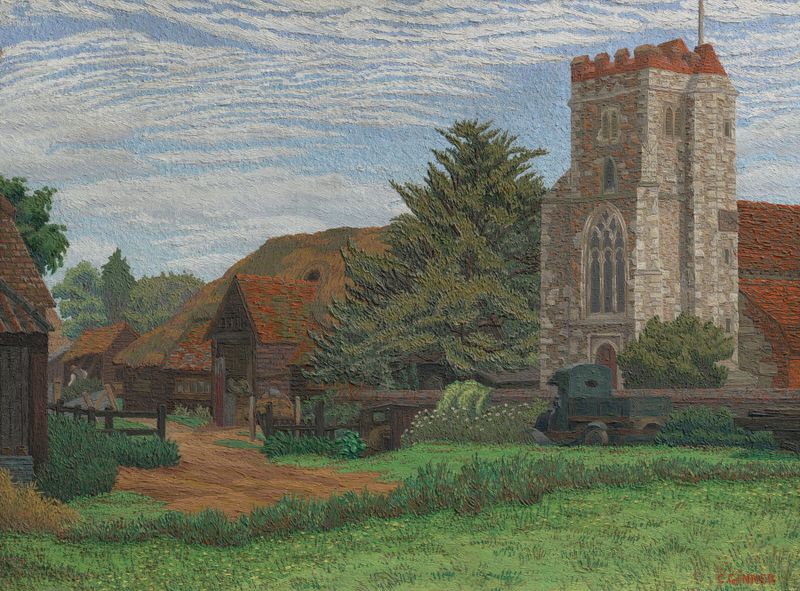
More Architecture Art
Browse all →
The statue of Liberty
Frédéric Auguste Bartholdi

View of Houses in Delft, Known as ‘The Little Street’
Johannes Vermeer

View of Houses in Delft, Known as ‘The Little Street’
Johannes Vermeer

The Cathedral in Rouen. The portal, Grey Weather
Claude Monet

The yellow house
Vincent van Gogh

The Church in Auvers-sur-Oise, View from the Chevet
Vincent van Gogh