Salzburg, a View of St. Peter’s Cemetery — History & Facts
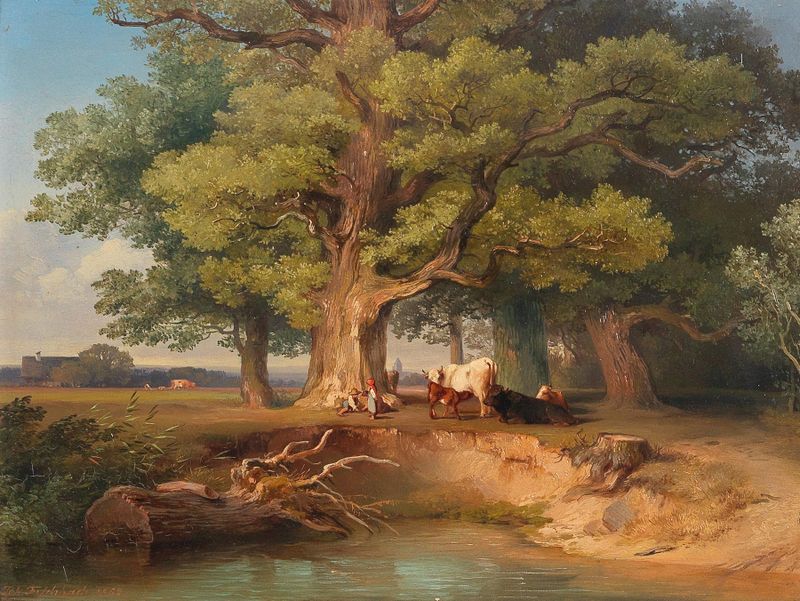
In the stillness of a cemetery, life and death coexist, whispering tales of those who came before us. Each gravestone stands as a muted testament to human fragility, a gentle reminder of mortality lingering in the air. Focus first on the soft, muted colors that dominate the canvas, guiding your gaze through the tranquil landscape. The earthy browns and greens are punctuated by the pale hues of weathered stone, creating an atmosphere that is both serene and somber.
Notice how the dappled sunlight filters through the trees, casting delicate shadows on the graves, inviting reflection and contemplation. The subtle arrangement of the tombstones, both clustered and solitary, emphasizes the solitude inherent in the human experience. Beneath its quiet exterior, the painting reveals profound emotional tensions. The contrasting light and shadow playfully dance on the gravestones, symbolizing the perpetual struggle between life and death.
The overhanging branches, protective yet isolating, suggest the interconnectedness of nature and mortality, while the absence of human figures amplifies the feeling of solitude. One can't help but sense that each stone holds stories unspoken, echoing with memories of those who have passed, challenging the viewer to consider their own legacy. In 1841, Johann Fischbach painted this poignant piece in Salzburg, a city steeped in history and culture. At that time, the Romantic movement was flourishing, emphasizing emotion and the sublime in nature as artists turned their focus on personal introspection.
Fischbach, influenced by these currents, created a work that resonates with quiet dignity, reflecting both the beauty and inevitability of human life, and the ephemeral nature of existence itself.