St. Anthony Abbot and St. Paul the Hermit — History & Facts
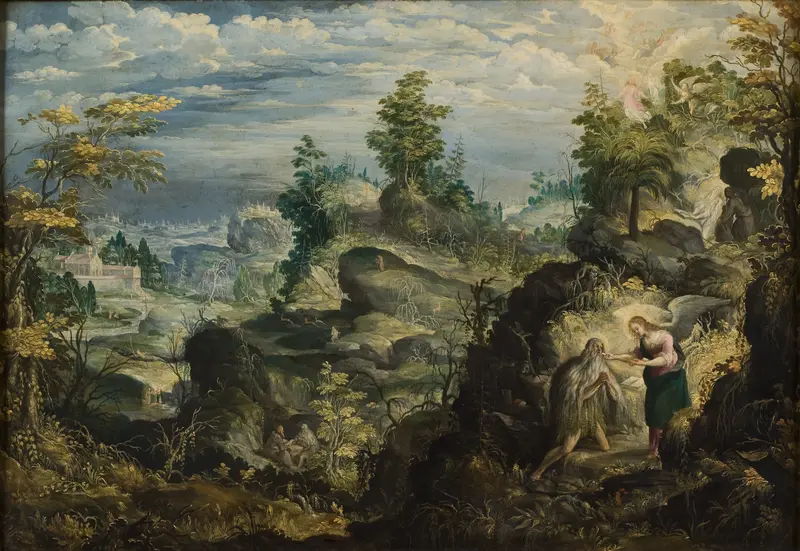
A restless sky churns above a wild, overgrown landscape, drawing the viewer into a world where the miraculous seems possible at any moment. At the painting’s lower right, two figures command attention: one, robed and contemplative, gestures in conversation with a wild-haired elder clad in leaves, who lifts a raven toward the heavens. The eye is led by a shaft of light that breaks through the clouds, illuminating these saints and casting their meeting as a moment of revelation.
All around them, the land teems with detail—gnarled roots, mossy stones, and distant hermits—while a radiant vision of angels glows in the sky, hinting at the spiritual drama unfolding below. The city on the horizon, far removed from this wilderness, stands as a silent witness to the solitude and sanctity of the scene. Painted in 1641, this work belongs to a tradition that flourished in the Baroque era, when artists across Europe delighted in stories of hermit saints and their mystical encounters. Such paintings were often commissioned for private devotion or monastic settings, inviting viewers to contemplate the virtues of withdrawal and spiritual struggle.
The unknown medium and the obscurity of Antonín Stevens only deepen the painting’s sense of mystery—history has kept few traces of the artist or the journey of this particular canvas, now found in a digital collection. Yet the lush, almost theatrical landscape and the interplay of light and shadow invite us to linger, searching for meaning in every leaf and every gesture.