Madonna of the Goldfinch: meaning and location
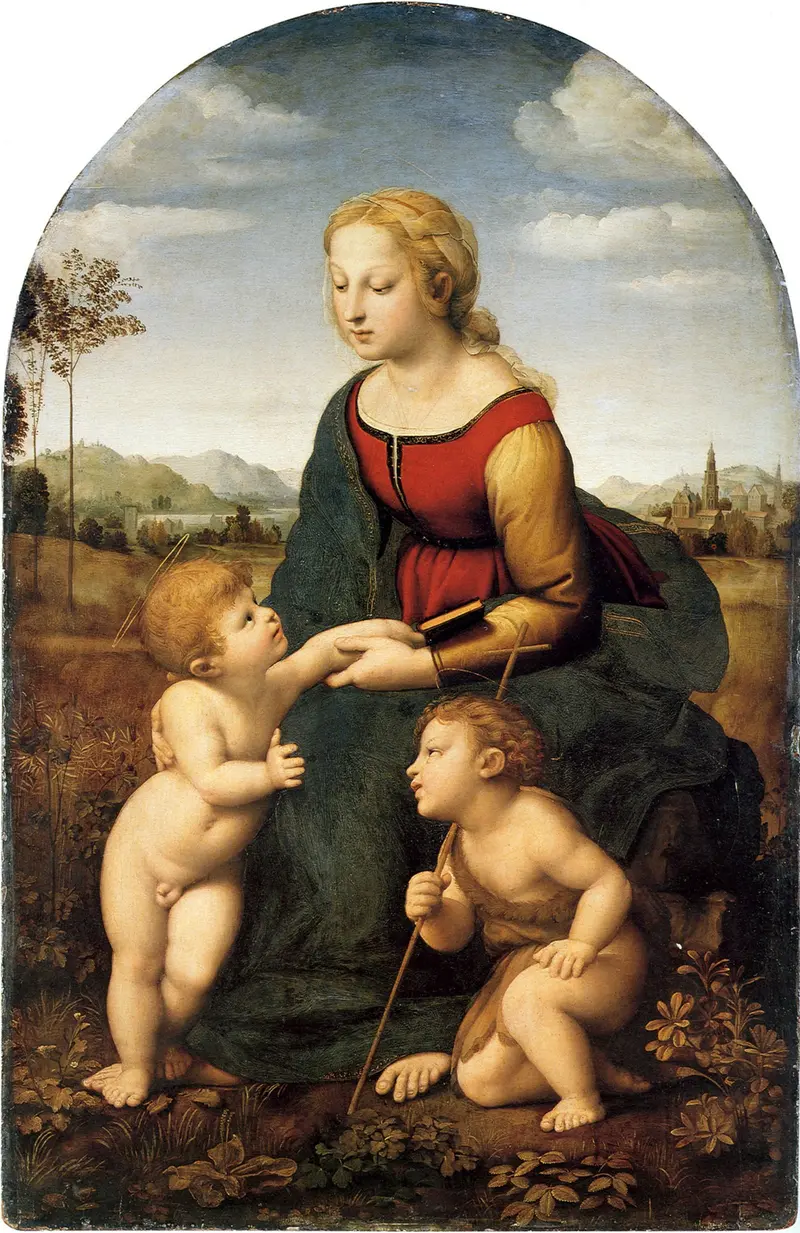
Seventeen fragments: that is what the panel was reduced to when the Palazzo Nasi in Florence collapsed in a landslide on 12 November 1547, according to the Opificio delle Pietre Dure. Madonna of the Goldfinch (Madonna del Cardellino) was painted around 1506 by Raphael (1483–1520) for the wool-cloth merchant Lorenzo Nasi, on Vasari’s account for his wedding. Reassembled in the sixteenth century and restored again over about ten years up to 2008, this panel, which Wikidata places in the High Renaissance, belongs to the Uffizi Gallery.
- A panel in three pieces: the original support was two poplar boards, and the right-hand board split in two in the collapse, so the panel broke into three large pieces. The sixteenth-century repair, which Antonio Natali attributes to Ridolfo del Ghirlandaio, was kept as historically significant. The Opificio estimates, from digital analysis, that about 20% of the paint is lost.
- A drawing under the paint: infrared reflectography showed a preliminary drawing at full scale, with pounce dots. According to the Ministry of Culture, it differs from the finished picture: a tower and a cylindrical building on the right became open space, and the Virgin’s neckline and the position of Saint John’s ear changed.
- Gold only in the halos: the Opificio found that gold, applied as shell gold, is limited to the three halos. The painting is oil on panel and measures 107 × 77.2 cm; it carries Uffizi inventory 1890 no. 1447.
- Cleaned with a scalpel: the restorers removed a thick, yellowish nineteenth-century varnish that had darkened and cracked, working mostly with a scalpel under a stereomicroscope. They kept sixteenth-century additions where they were historically integrated, and earlier repairs of 1804 and 1821 are documented.
- From Nasi house to the Uffizi: the Ministry’s release says the panel probably stayed with the Nasi family until their male line ended in 1639, was bought by Cardinal Giovan Carlo de’ Medici, and entered the Uffizi in 1704, in the Tribuna.
Sources: Opificio delle Pietre Dure: record on the Madonna del Cardellino · Ministry of Culture: press release on the restored Madonna del Cardellino (Nov 2008) · Wikidata Q2344505
Questions and answers about the painting
What does Madonna of the Goldfinch show?
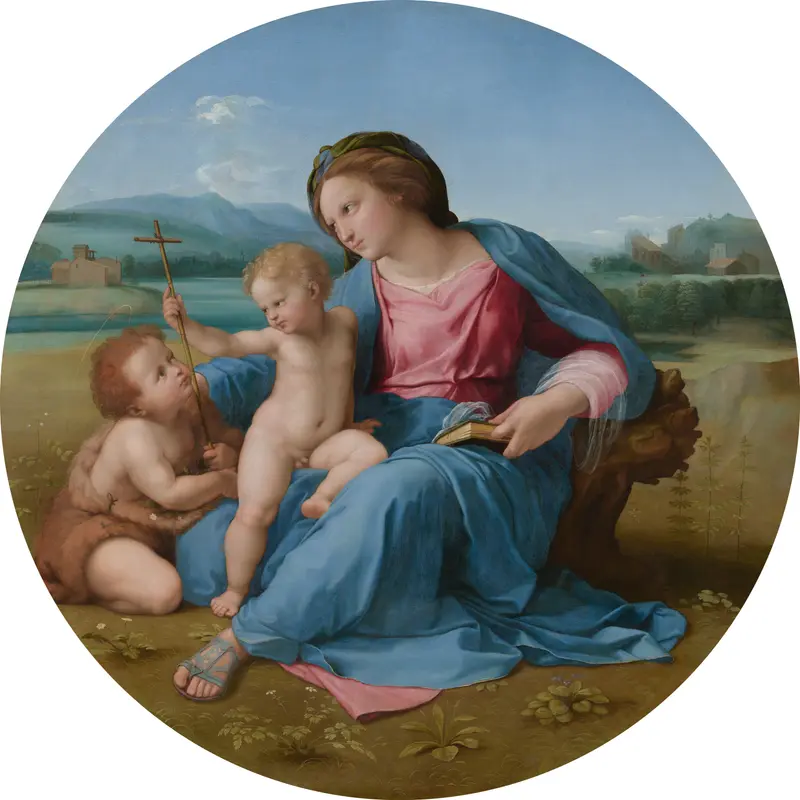
The painting shows the Virgin Mary with the Christ Child and the young Saint John the Baptist, who holds out a bird. Wikidata lists these three figures and a European goldfinch as the subjects, and it quotes Vasari’s 1568 description of a child between the Virgin’s knees, to whom a joyful little Saint John offers a bird. The Opificio’s record, which notes gold only in the three halos, does not interpret the bird, so this page offers no symbolic reading.
Source: Wikidata Q2344505 · Opificio delle Pietre Dure: record on the Madonna del Cardellino
Where is Raphael’s Goldfinch Madonna today?
The panel belongs to the Uffizi Gallery in Florence, where its inventory number is 1890 no. 1447. It has been in the Uffizi since 1704 according to the Ministry of Culture, which says it was first placed in the Tribuna; Wikidata gives 1666. The museum’s own room and opening arrangements change, so check with the Uffizi before a visit; this page gives no room number.
Source: Ministry of Culture: press release on the restored Madonna del Cardellino (Nov 2008) · Opificio delle Pietre Dure: record on the Madonna del Cardellino
What happened to Raphael’s panel in 1547?
The Palazzo Nasi in Florence’s Via de’ Bardi collapsed after a landslide on 12 November 1547, and the panel was buried in the rubble and broken into seventeen fragments, according to the Opificio delle Pietre Dure. Other texts give slightly different dates: Vasari wrote 1548, and the Ministry of Culture says the collapse happened at the end of 1547. The pieces were put back together in the sixteenth century, with wooden pegs and long metal nails.
Source: Opificio delle Pietre Dure: record on the Madonna del Cardellino · Ministry of Culture: press release on the restored Madonna del Cardellino (Nov 2008)
Who commissioned Raphael’s painting of the Virgin with Saint John?
The merchant Lorenzo Nasi, according to Vasari, whom both the Opificio and the Ministry of Culture cite. Nasi was a wealthy wool-cloth merchant and a friend of Raphael, who lived in Florence from 1504 to 1508. The occasion was Nasi’s marriage to Sandra Canigiani, which the Ministry places probably in 1505 and in any case before 23 February 1506. Wikidata also records Nasi as the commissioner.
Source: Ministry of Culture: press release on the restored Madonna del Cardellino (Nov 2008) · Opificio delle Pietre Dure: record on the Madonna del Cardellino · Wikidata Q2344505
What did the restoration of Raphael’s panel reveal?
The Opificio’s ten-year study and restoration, announced as complete in November 2008, recovered Raphael’s colour under old varnish and repaint. X-rays showed the cracks and the nails of the first repair, and infrared reflectography revealed the full-scale underdrawing. The restored panel was shown at Palazzo Medici Riccardi in Florence from 23 November 2008 to 1 March 2009.
Source: Opificio delle Pietre Dure: record on the Madonna del Cardellino · Ministry of Culture: press release on the restored Madonna del Cardellino (Nov 2008)
Is Raphael’s Goldfinch Madonna in the public domain?
Yes. Raphael died in 1520, so his paintings are free of copyright everywhere, and this one is no exception. A faithful photograph of a public-domain painting adds no new copyright in the United States or the European Union, so you can download this image and use it in personal or commercial projects. Public Domain Images for Commercial Use explains how.