
Stadhuis en Markt te Bergen op Zoom — History & Facts
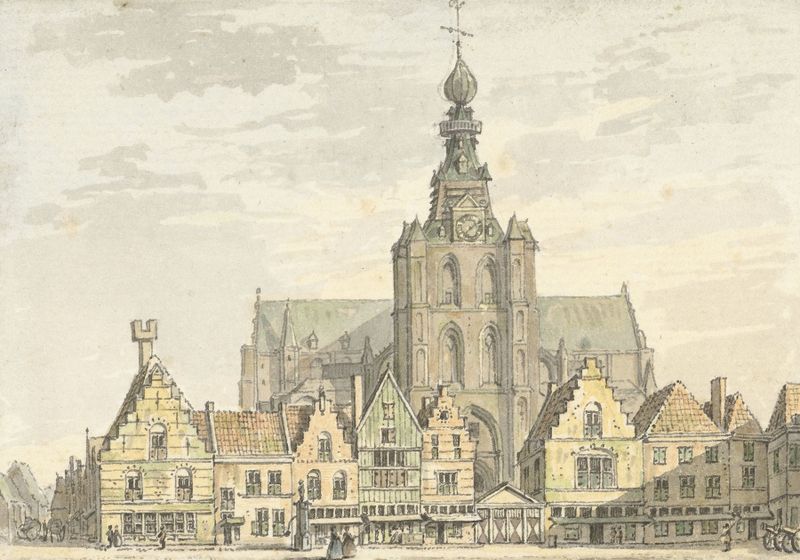
What if beauty was never meant to be finished? This notion lingers in the crisp air of Stadhuis en Markt te Bergen op Zoom, inviting us to explore the interplay between architecture and humanity. Look to the center where the grand town hall rises majestically against the backdrop of an expansive sky, its intricate façade capturing light in a dance of shadows and brilliance. The cobblestone streets lead the eye towards the bustling market scene, where figures in period clothing move purposefully, their gestures hinting at commerce and camaraderie. The artist’s vibrant palette breathes life into the canvas, with warm ochres and deep blues creating a harmony that beckons the viewer to linger. Delve deeper into the interplay of light and shadow, where the delicate balance of urban life is captured.
The crowds, seemingly animated, reflect the ebbs and flows of society, contrasting with the stillness of the architecture that looms above. This juxtaposition evokes a sense of permanence against the fleeting nature of human activity, suggesting that the truth of existence lies in both the stability of the structures we create and the transitory moments we inhabit. Abraham de Haen the Younger painted this work in 1739 during a time when the artistic scene in the Netherlands was experiencing a resurgence of interest in local landscapes and town life. Living in a period marked by economic growth and urban development, he sought to encapsulate the essence of Bergen op Zoom at a time when civic pride and cultural identity were blossoming, rendering a historical snapshot that resonates through time.
More Artworks by Abraham de Haen the Younger
Browse all →
More Architecture Art
Browse all →
The statue of Liberty
Frédéric Auguste Bartholdi

View of Houses in Delft, Known as ‘The Little Street’
Johannes Vermeer

View of Houses in Delft, Known as ‘The Little Street’
Johannes Vermeer

The Cathedral in Rouen. The portal, Grey Weather
Claude Monet

The yellow house
Vincent van Gogh

The Church in Auvers-sur-Oise, View from the Chevet
Vincent van Gogh