
Temple of Heaven in Beijing Viewed through a Gate — History & Facts
How does one transform the ephemeral nature of existence into something eternal? A moment captured, a breath held—mortality dances with the divine in the hands of the artist. Look to the center of the composition, where the majestic Temple of Heaven rises, a bright jewel framed by the arch of a gate. The vibrant blue tiles glimmer under the soft, filtered light, drawing the eye toward its intricate patterns and curvilinear forms. The gate’s muted earth tones create a stark yet harmonious contrast, emphasizing the sacred structure beyond.
Notice how the muted hues surrounding the arch serve to elevate the temple, inviting contemplation and reverence. Diving deeper, the interplay between the gate and the temple symbolizes the threshold between life and the afterlife, a poignant reminder of mortality. The juxtaposition of the earthly frame and the celestial shrine speaks to the transient nature of human existence against the backdrop of enduring beauty. Subtle shadows deepen the emotional weight, hinting at the passage of time and the inevitable decay that accompanies life, yet there is a profound grace in this transition. In 1923, Lishou Huang painted this evocative work amid a profound cultural shift in China, where traditional values faced the encroachment of modernity.
At this time, artists were exploring new avenues of expression while grappling with the remnants of a rich heritage. Huang’s ability to meld the ancient with the contemporary speaks to his unique vision, as he sought to preserve the essence of his culture during a time of great change.
More Artworks by Lishou Huang
Browse all →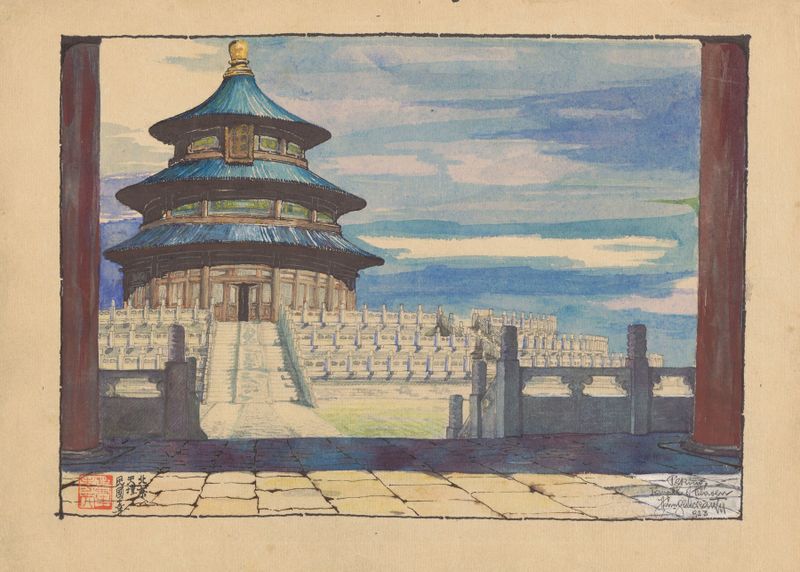

More Architecture Art
Browse all →
The statue of Liberty
Frédéric Auguste Bartholdi

View of Houses in Delft, Known as ‘The Little Street’
Johannes Vermeer

View of Houses in Delft, Known as ‘The Little Street’
Johannes Vermeer

The Cathedral in Rouen. The portal, Grey Weather
Claude Monet

The yellow house
Vincent van Gogh

The Church in Auvers-sur-Oise, View from the Chevet
Vincent van Gogh