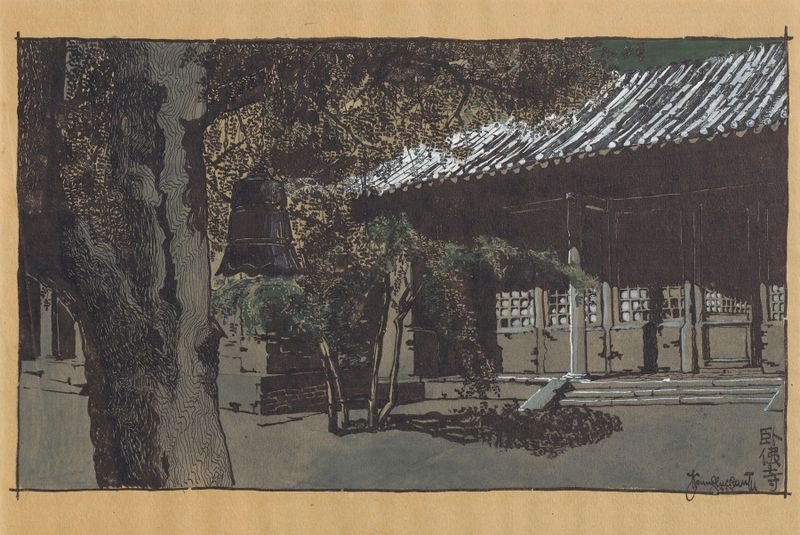
Bridge Leading to the Gate of Dezhou, Shandong — History & Facts
What if silence could speak through light? In Bridge Leading to the Gate of Dezhou, Shandong, the stillness of a moment invites contemplation, whispering secrets of longing and connection. Look to the left at the elegantly arching bridge, its muted tones contrasting with the vibrant greenery that envelops it. The artist employs a delicate palette, allowing soft earth tones to harmonize with the bright blues of the sky. Notice how the light bathes the bridge in a gentle glow, drawing your eye towards the inviting gate that beckons in the distance.
The composition frames a pathway, a metaphorical journey that transcends mere physicality and calls upon deeper emotional resonance. In this piece, the juxtaposition of the sturdy structure of the bridge against the ethereal quality of light reflects the tension between the tangible and the intangible. Each brushstroke conveys a yearning, an unsatisfied desire for what lies beyond the gate. The lush landscape surrounding the path hints at the beauty of possibility, yet the emptiness of the scene evokes a sense of solitude.
This interplay invites viewers to explore their own feelings of longing and connection. Lishou Huang created this work in 1922, during a pivotal time in China's artistic evolution. Emerging from the turbulence of the early 20th century, he sought new forms of expression that blended traditional Chinese aesthetics with modern influences. The Shandong region, rich in cultural history, served as both inspiration and backdrop for Huang, whose art reflected the profound transformations occurring in society and the quest for identity during this era.