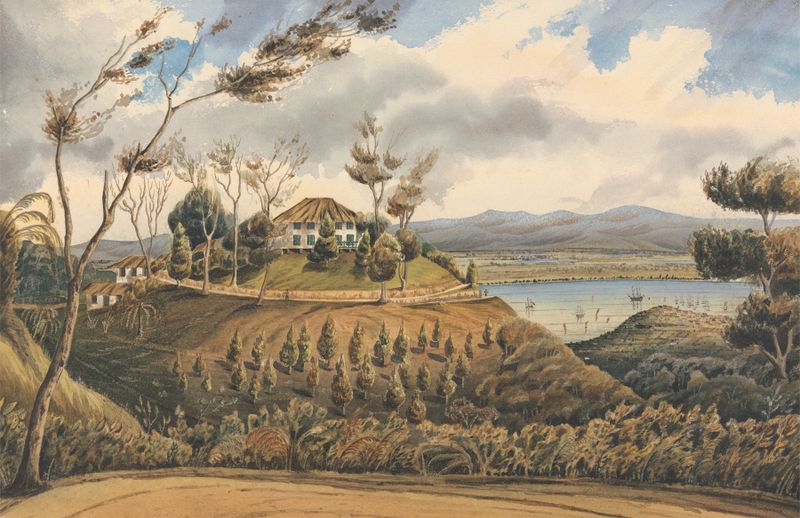
The Admiral House, Simon’s Town, Cape of Good Hope — History & Facts
The delicate interplay of color in a landscape can evoke the essence of a place, transcending the mere replication of reality. Look closely at the warm hues that wash over the upper sections of the canvas, where soft golds and gentle ochres blend seamlessly into the azure sky. Notice how the artist uses a palette of earthy tones in the foreground, grounding the scene in the rugged landscape. The interplay of light and shadow breathes life into the undulating hills, while the vibrant blues of the sea invite contemplation, drawing the viewer's eye toward the horizon. Beneath this beautifully composed image lie layers of meaning.
The contrast between the tranquil sea and the rocky terrain reflects the tension between man and nature, suggesting a fragile coexistence. The presence of the Admiral House, poised amidst this backdrop, symbolizes human endeavor in a wild, untamed world—an assertion of civilization against the vastness of nature. Each brushstroke embodies a moment in time, whispering stories of the lives lived within those walls and the dreams forged under the Southern skies. In 1844, Lt.
Humphrey John Julian was stationed in Simon's Town, South Africa, serving with the British Navy. This period marked a time of colonial exploration and expansion, and Julian’s artistry was influenced by the landscapes he encountered. As he painted The Admiral House, he captured not just a physical place but a pivotal moment in the intersection of military history and the burgeoning appreciation for natural beauty, reflecting the complex era in which he lived.