The Elbe at Blankenese — History & Facts
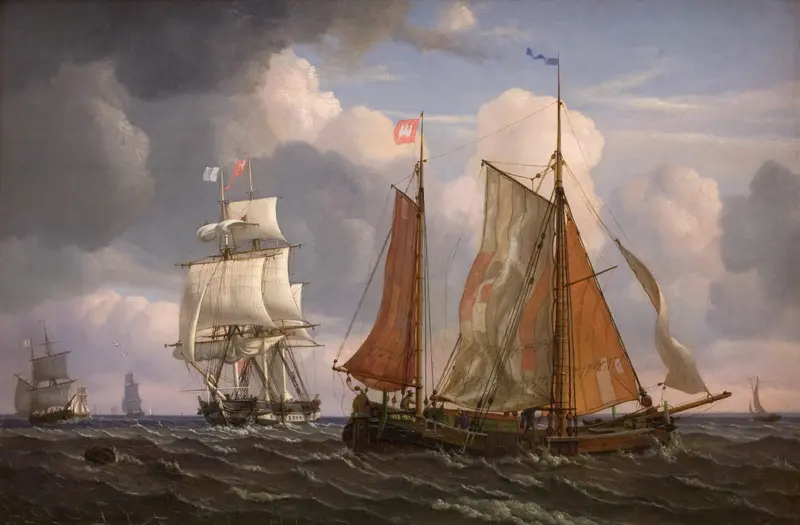
What first commands attention in The Elbe at Blankenese is the sheer breadth of sky, its restless, rolling clouds dwarfing the ships and figures below. The artist draws the viewer into a world of movement and anticipation: a ship with billowing sails edges towards the shore, its crew busy with the tasks of arrival. The wet sand glistens, reflecting the hulls and the low, cool light, while tufts of grass and a beached anchor in the foreground root the scene in the tactile world.
Every gesture is purposeful—the figures on the beach stride forward, the sails strain with the wind, and the river churns in their wake. The palette, dominated by silvery blues and earthy greens, sets a mood of brisk, industrious calm, as if the day’s work is only just beginning. This is the world of northern European river landscapes in the mid-nineteenth century, when artists like Adolph Friedrich Vollmer turned their gaze to the working life along the waterways that fed the growing cities. Painted in 1844, this scene belongs to a tradition that celebrated both the natural drama of the river and the human stories unfolding along its banks.
Such works were often commissioned by merchants or collectors with ties to the shipping trade, eager to capture the pulse of commerce and the beauty of familiar places. History has kept few traces of the journey of this particular painting, now in the Bridgeman Art Library, but its details—rigging, cargo, the bustle of figures—speak to a time when the Elbe was a highway of ambition and daily labor. Let your eye linger on the horizon, where ships fade into the haze, and imagine the stories still waiting to dock.