The interior of the church of Santa Maria Sopra Minerva in Rome — History & Facts
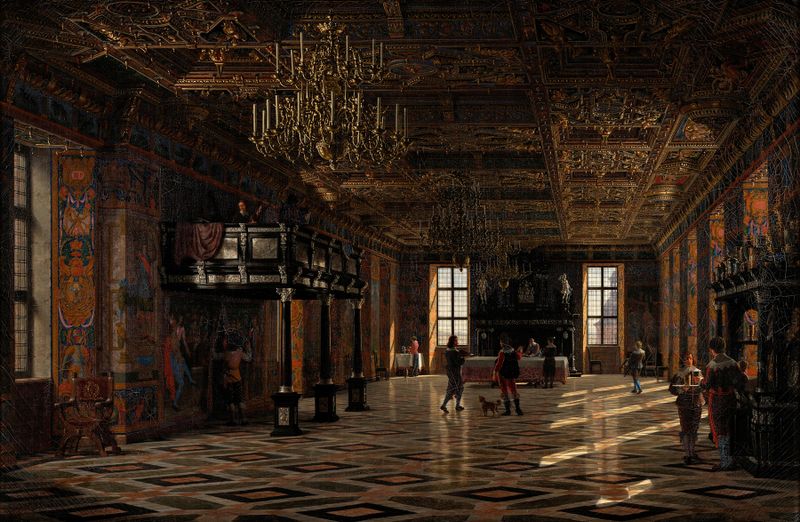
What secret hides in the quiet of the canvas? In a moment suspended between the sacred and the mundane, The interior of the church of Santa Maria Sopra Minerva in Rome invites us into a space brimming with hushed reverence and unspoken stories. Look to the left at the intricate details of the church’s altar, where decorative elements merge with the soft glow of filtered light. The delicate play of shadows reveals the craftsmanship of Hansen’s brushwork, showcasing the ornate columns and vaulted ceilings that rise majestically above. The colors are woven together with a muted palette of earthy tones and soft pastels, evoking both tranquility and a sense of awe.
Each stroke builds a narrative, guiding the viewer’s gaze through the serene architecture. Beneath the serene exterior lies a dichotomy; the stillness within the church contrasts sharply with the revolutionary spirit of the time. Hansen encapsulates a moment when faith and socio-political fervor coexisted uneasily. The meticulous detail of the artwork invites contemplation of the spiritual reverence and the underlying tensions of 19th-century Italy, where the fervor for unification clashed with traditional structures of power.
Each visitor, lost in their thoughts, becomes a silent witness to both hope and yearning. Heinrich Hansen created this piece in 1874, during a period of significant political upheaval in Italy. As the nation grappled with the implications of unification, the artist was immersed in a vibrant art scene in Rome, where the church’s grandeur became a canvas for both artistic expression and societal reflection. His work is a testament to the era, blending the beauty of heritage with the pulse of change.