The Long Gallery, Haddon Hall, Derbyshire — History & Facts
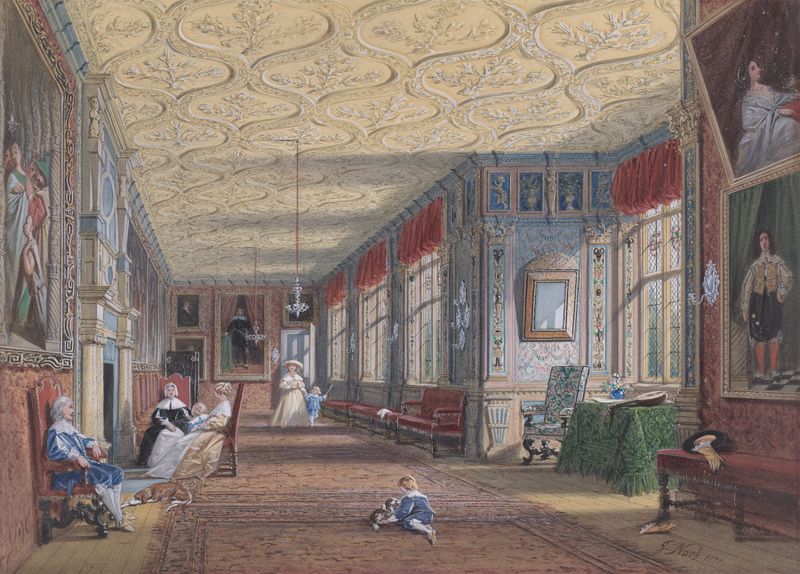
In the quiet of stillness, a moment captured in time reveals the passage of day and the whispers of mortality that linger in the air. Look closely at the foreground, where elegant arches frame a long corridor that beckons the viewer into its depths. Notice how the muted light floods through tall windows, casting elongated shadows that dance along the stone floor. The rich ochres and earthy greens envelop the space, enhancing both the grandeur and the weight of history that resides in Haddon Hall.
Each brushstroke meticulously details the architectural elements, inviting contemplation of the souls who once traversed this very gallery. Yet, as one gazes deeper, an unsettling contrast emerges: the beauty of the surroundings juxtaposed with a sense of decline. An array of portraits hangs on the walls, their gazes fixed and eternal, silently observing the passage of time. This tension between the vibrant life once lived and the fading echoes of existence weaves through the composition, reminding us of our own fragility and the inevitable journey toward oblivion. In 1839, Joseph Nash painted this piece during a period of intense interest in the Gothic revival and the English heritage scene.
As an artist dedicated to capturing the architecture and landscapes of England, he was immersed in a world teetering between nostalgia for the past and the blossoming of modernity. The artist's meticulous attention to historical detail reflects not only his personal experiences but also a collective consciousness grappling with the transient nature of life.