The Manor of Krabbesholm in Jutland — History & Facts
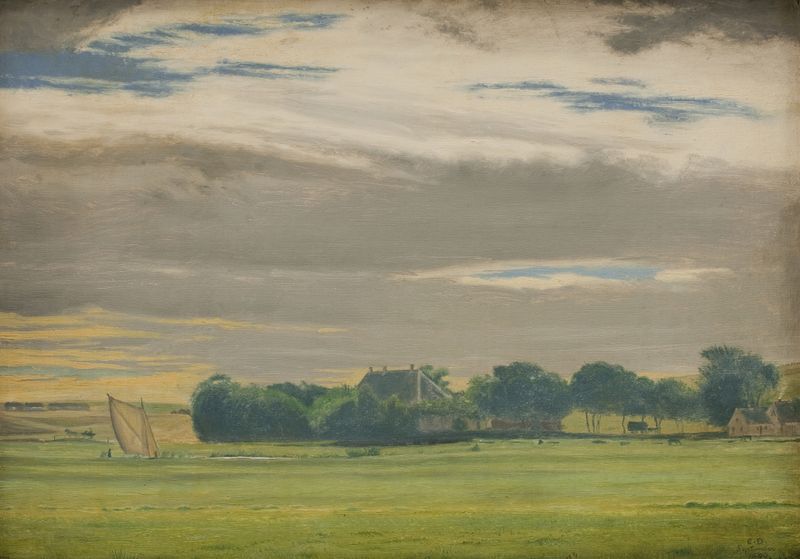
In stillness, a profound emptiness speaks volumes, inviting us to explore the unseen narratives that linger on the canvas. Look towards the horizon, where the Manor of Krabbesholm stands resolutely against a muted sky. The subtle palette of soft greens and grays evokes a sense of serenity, while the light bathes the manor's façade in a delicate glow, suggesting both warmth and neglect. Notice how the foreground, painted with a gentle brushstroke, gradually gives way to the vast emptiness of the landscape, emphasizing the isolation of the manor and its surroundings. In this composition, the contrast between the sturdy structure and the open space around it captures the tension between human endeavor and nature's indifference.
One can sense an underlying loneliness, as if the manor holds remnants of stories long forgotten. The sparse details—like the few scattered trees—serve as poignant symbols of solitude, hinting at the passage of time and the inevitable decay of once-vibrant life. Created during a period of artistic transition in Denmark, this work reflects Christen Dalsgaard's journey from Romanticism towards a more realistic portrayal of landscapes. Painted between 1839 and 1907, Dalsgaard navigated the changing tides of artistic expression, capturing the essence of rural life and the profound beauty found in desolation.
As he stood before this landscape, he immortalized a moment where silence and emptiness could elicit deep introspection.