
The Old Custom House, Monterey — History & Facts
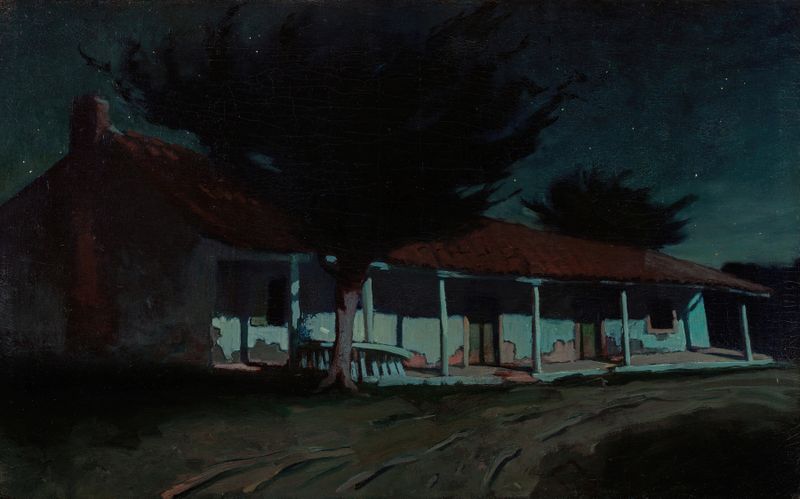
Can beauty exist without sorrow? In The Old Custom House, Monterey, the answer lies in the delicate balance of colors and forms, a dance of light and shadow that invites deeper contemplation. Look to the left at the weathered textures of the building's façade, where the peeling paint tells a story of time's relentless passage. Notice how the golden hues of the sun wash over the stone, creating a warm contrast against the cool, muted blues of the sky. The composition draws the eye towards the archway, framed by the branches of the overhanging trees, subtly hinting at a world beyond—a whisper of life intertwined with history. The scene evokes a sense of nostalgia, a longing for simpler days where the weight of the past clashes with the fleeting nature of the present.
The old custom house stands as a silent witness to countless lives, its stoic presence hinting at both the madness of change and the beauty in endurance. Each brushstroke captures the tension between decay and vibrancy, suggesting that sorrow and beauty are not opponents, but rather intertwined companions in the human experience. In the early 20th century, Peters painted this piece amid a flourishing movement of American Impressionism, a time when artists sought to capture fleeting moments in nature and life. Living in California, he drew inspiration from the landscape and architecture around him, reflecting both the charm of the region and the inevitable march of time that would challenge its serenity.
More Artworks by Charles Rollo Peters
Browse all →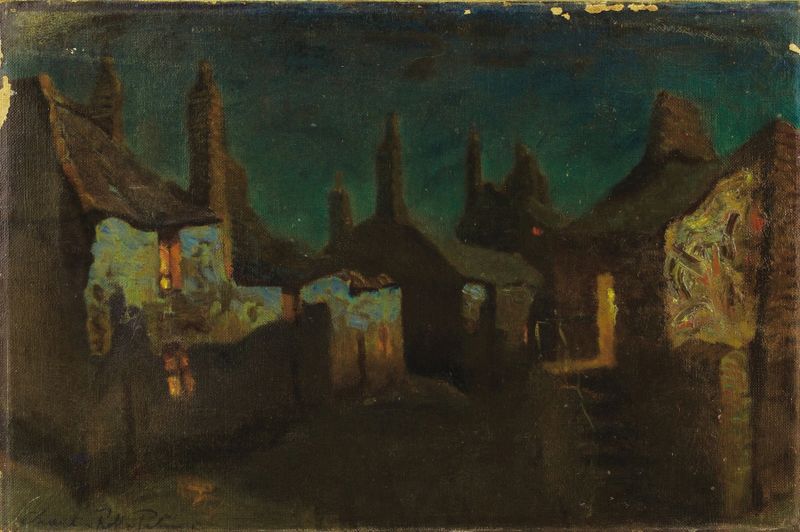
More Architecture Art
Browse all →
The statue of Liberty
Frédéric Auguste Bartholdi

View of Houses in Delft, Known as ‘The Little Street’
Johannes Vermeer

View of Houses in Delft, Known as ‘The Little Street’
Johannes Vermeer

The Cathedral in Rouen. The portal, Grey Weather
Claude Monet

The yellow house
Vincent van Gogh

The Church in Auvers-sur-Oise, View from the Chevet
Vincent van Gogh