The Thirteen Emperors — History & Facts
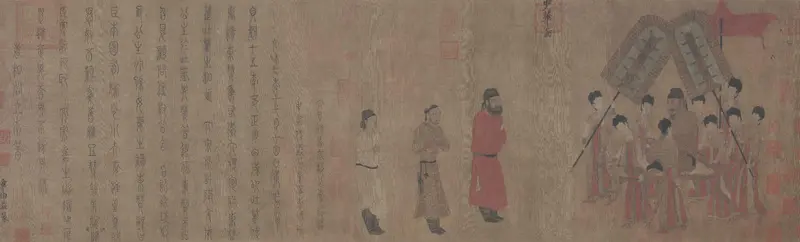
The Thirteen Emperors is a handscroll painting attributed to Yan Liben and dated to the 7th century. Executed in ink and color on silk, the scroll presents a series of imperial figures identified as rulers from earlier Chinese dynasties. The work is recognized for its historical subject matter and its association with the Tang dynasty, a period noted for advancements in figure painting and portraiture. The scroll depicts thirteen emperors, each accompanied by attendants, arranged in a continuous horizontal procession.
The figures are rendered in a formal, upright posture, wearing elaborate robes and headgear, with inscriptions above identifying each emperor. The palette is dominated by reds, blacks, and muted earth tones, while the outlines and facial features are carefully delineated, characteristic of early Chinese court painting. The composition emphasizes hierarchy and dignity, with each emperor presented in a distinct grouping. This work is an important example of Chinese imperial portraiture from the Tang dynasty.
Handscrolls of this type were often created to record and honor historical figures, serving both didactic and commemorative functions at court. The Thirteen Emperors is documented as originating in the 7th century, and it survives as a significant artifact of early Chinese painting. It is now in the Museum of Fine Arts, Boston, and is widely studied for its style and iconography.