
Toits de Paris — History & Facts
In the stillness of Parisian rooftops, a silent madness lingers, whispering the secrets of a city caught between dreams and despair. Each tile and chimney holds a fragment of history, an echo of lives intertwined, as if the very air is charged with unspoken tales of ambition and existential longing. Look to the top left, where the warm golden hues of the setting sun bathe the rooftops in soft light, creating a stark contrast against the cool grays of the sky. Notice how the artist layers the textures, capturing the uneven surfaces of the sloping roofs and their irregular lines, which suggest both fragility and resilience.
The gentle rise and fall of the buildings guide the eye, inviting the viewer to traverse this urban landscape, while the palette invokes a sense of nostalgia tinged with melancholy. As you explore further, consider the subtle interplay of light and shadow, which hints at the chaos lurking beneath this tranquil facade. The juxtaposition of the orderly arrangement of rooftops against the erratic clouds above resonates with the tension of urban life—a delicate balance between serenity and turmoil. Each element symbolizes the madness of a city alive with ambition, where dreams rise and fall as swiftly as the sun sinks beneath the horizon. In 1870, as Cuisin created this piece, Paris was a city on the brink of transformation.
The Franco-Prussian War loomed, and the artistic community was grappling with the rise of modernism. The artist painted during a time of great upheaval, reflecting the broader societal tensions and the urgent need for expression amidst chaos. This work encapsulates the essence of a world teetering between the old and the new, mirroring the madness of its time.
More Artworks by Charles-Emile Cuisin
Browse all →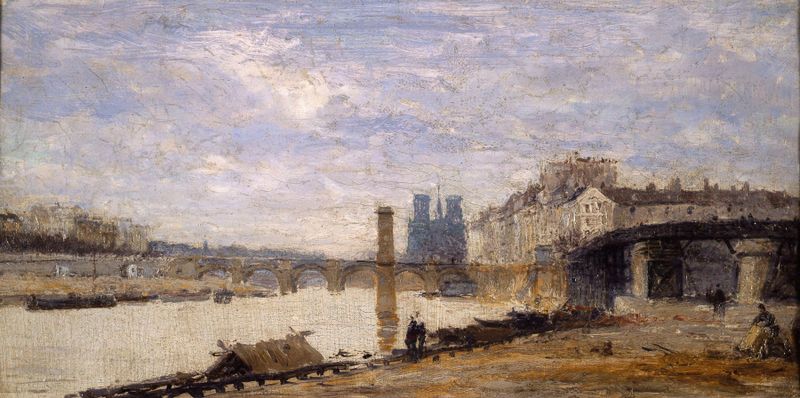

More Architecture Art
Browse all →
The statue of Liberty
Frédéric Auguste Bartholdi

View of Houses in Delft, Known as ‘The Little Street’
Johannes Vermeer

View of Houses in Delft, Known as ‘The Little Street’
Johannes Vermeer

The Cathedral in Rouen. The portal, Grey Weather
Claude Monet

The yellow house
Vincent van Gogh

The Church in Auvers-sur-Oise, View from the Chevet
Vincent van Gogh