Venice — History & Facts
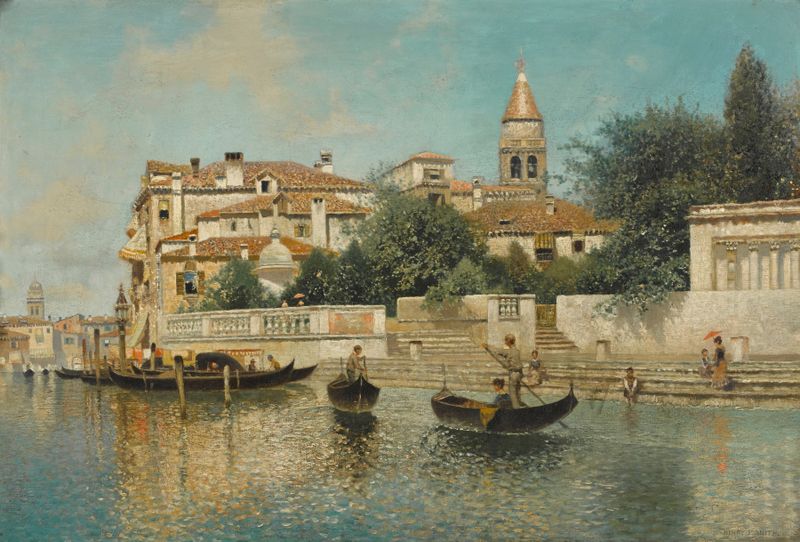
Who listens when art speaks of silence? In the stillness of Venice, a whisper of fragility lingers, capturing the heart of a city suspended in time. Focus on the luminous reflections dancing upon the water's surface, where muted tones of blue and gray intertwine with soft hints of gold. Notice how the artist’s deft brushwork gives life to the delicate gondolas gently rocking, their forms softened by the encompassing mist. The ethereal quality of the light creates a haunting yet serene atmosphere, inviting the viewer to linger in this moment, as if trapped between dream and reality. Yet, amid the tranquil beauty lies an underlying tension.
The narrow canals, while inviting, evoke a sense of solitude, suggesting the isolation inherent in such breathtaking scenery. The juxtaposition of the vibrant life above the water and the stillness below hints at the fragility of existence, reminding us that beauty often coexists with transience. Each brushstroke reveals a longing for connection in a world where silence reigns, urging the viewer to ponder the stories held within the shadows and reflections. Created in 1890, this piece emerged during a time when Henry Pember Smith was immersing himself in the romantic allure of Venice, a city that captivated many artists.
His focus on capturing the essence of this iconic location evoked the spirit of the late Victorian period, a time when art began to explore deeper emotional resonances. As a member of the Royal Society of British Artists, he contributed to a movement that embraced both realism and romanticism, blending the two to create a visual language rich with introspection.