
View Of An Imaginary Palace — History & Facts
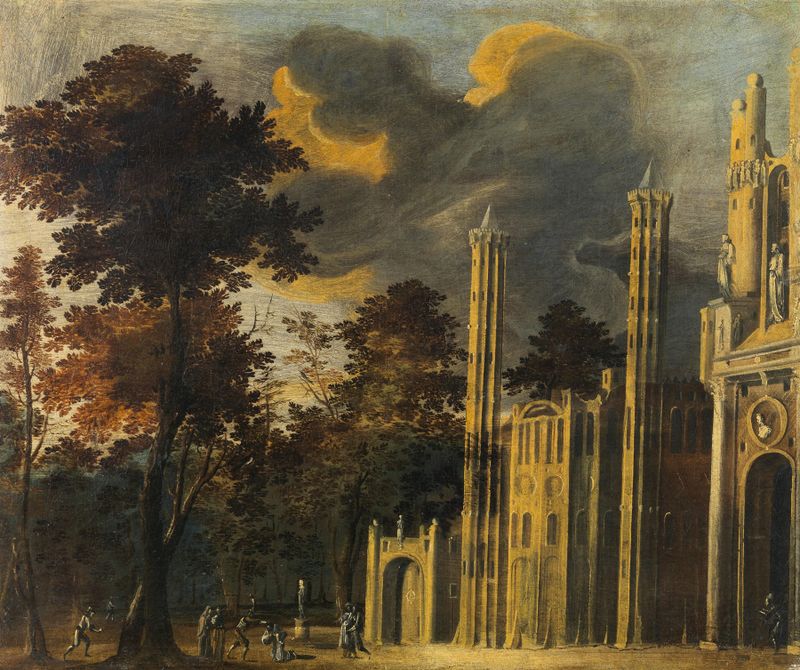
In this mesmerizing work, the viewer is confronted with an intricate vision of a palace that exists only in the imagination, a landscape echoing both grandeur and profound loss. Look to the center of the canvas where the imagined palace rises, its towers reaching upward with an ethereal glow. The soft palette of blues and golds bathes the structure in a dreamlike quality, while the delicate interplay of shadow and light reveals the ornate details of its architecture. The carefully rendered foliage surrounding the palace invites the eye to wander, suggesting a lush paradise that is both inviting and distant. Yet, amidst this enchanting scenery, there is an undercurrent of melancholy.
The harmonious lines of the palace contrast starkly with the tumultuous, swirling clouds above, hinting at an impending storm. Moreover, the muted reflections in the tranquil waters below suggest memories rippling through time, symbolizing what was lost in the passage of years. Each section of the painting carries an emotional weight, urging the viewer to contemplate the balance between beauty and transience. François de Nomé created this work during a period of artistic exploration in the late 16th to early 17th century, a time when the boundaries of imagination and reality began to blur in art.
Working in Paris, Nomé navigated a world filled with shifting ideals and the rise of new artistic movements. His imaginative palace serves as a poignant reflection of the aspirations and losses experienced in both his life and the broader art world of his time, encapsulating a yearning for what might have been.
More Artworks by François de Nomé
Browse all →
More Architecture Art
Browse all →
The statue of Liberty
Frédéric Auguste Bartholdi

View of Houses in Delft, Known as ‘The Little Street’
Johannes Vermeer

View of Houses in Delft, Known as ‘The Little Street’
Johannes Vermeer

The Cathedral in Rouen. The portal, Grey Weather
Claude Monet

The yellow house
Vincent van Gogh

The Church in Auvers-sur-Oise, View from the Chevet
Vincent van Gogh