
View of Namur from the West during the Siege of 1695 — History & Facts
What if beauty was never meant to be finished? In a quiet confrontation between chaos and serenity, one can feel the restless pulse of obsession echo through time. Focus first on the horizon, where the thundering clouds loom ominously over the besieged city of Namur. The golden hues of the sunset bleed into the gathering storm, reflecting the duality of hope and despair. Notice how intricately the artist captures the foreground's rugged terrain, with strokes that bring life to the earth itself, contrasting sharply against the distant, almost ethereal skyline.
The composition leads the eye through a symphony of colors—a palette of ochres, deep blues, and muted greens—that invites contemplation rather than action. Delve deeper into the hidden meanings tucked within this canvas. The juxtaposition of the beautiful landscape against the violence of war suggests a profound tension between nature's tranquility and humanity's relentless destructiveness. Each brushstroke seems to echo the artist's fixation, illustrating not just a moment in time but a longing for a beauty that may never be fully realized.
The unfinished edges of the clouds and the rawness of the land speak to the obsession with capturing a scene forever poised between creation and dismantling. Painted in 1695, this work emerged during a tumultuous period for Dirk Maas, when Europe was rife with conflict and transformation. Known for his landscapes, Maas was deeply influenced by the Baroque movement, which marveled at both nature's splendor and human folly. The Siege of Namur marked a pivotal point in the Nine Years' War, an event that would indelibly shape the artist's perception of beauty amidst destruction.
More Artworks by Dirk Maas
Browse all →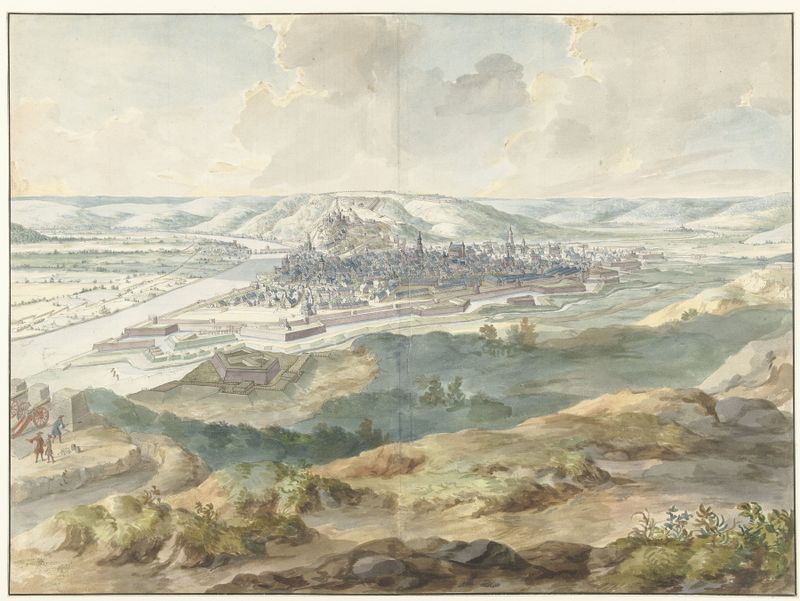
More Historical Art
Browse all →
The Night Watch Militia Company of District II under the Command of Captain Frans Banninck Cocq
Rembrandt van Rijn

Lincoln Memorial
Henry Bacon

The Third of May 1808
Francisco de Goya

Isaac and Rebecca, Known as ‘The Jewish Bride’
Rembrandt van Rijn

The Charge of the Mamelukes (1814)
Francisco de Goya

De vier ruiters van de apocalyps
Albrecht Dürer