
View over Ytterhogdal, Hälsingland — History & Facts
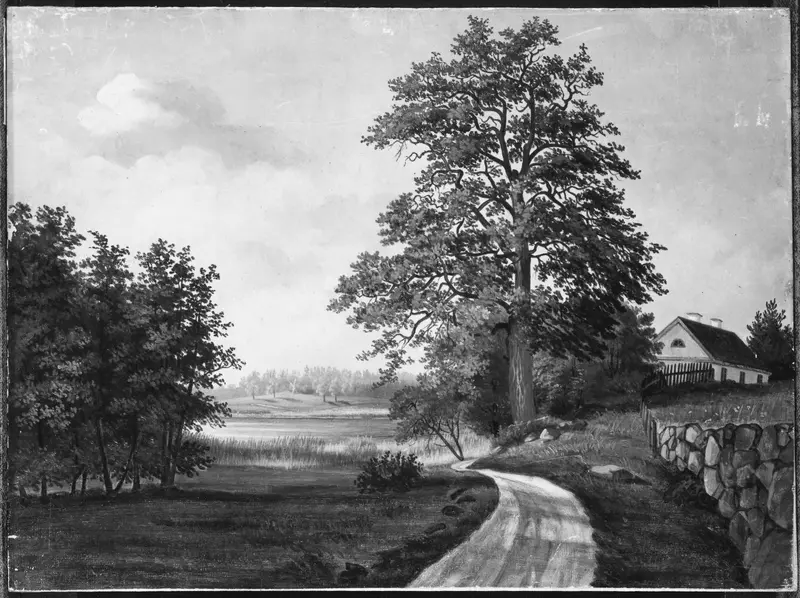
A winding road, pale as chalk, draws the viewer’s gaze through a patchwork of fields and pine woods, past a mirrored river, and onward toward the clustered heart of a rural Swedish village. In View over Ytterhogdal, Hälsingland, August Winqvist chooses a vantage that makes the landscape itself the main character, with the settlement’s church and houses nestled quietly into the middle distance. The sky, broad and softly clouded, dominates the composition, lending a sense of openness and calm, while the careful placement of fences and bridges hints at a community both connected and contained.
The bridge, almost at the painting’s center, is a visual hinge—uniting the cultivated foreground with the wooded hills beyond. Works like this, with their panoramic sweep and attention to local detail, belong to a tradition of Swedish landscape painting that flourished in the nineteenth century, when artists and patrons alike sought to document and celebrate the nation’s rural heartlands. Such images were often commissioned by local notables or created for civic pride, capturing the look and feel of a place in an era of rapid change. The date of Winqvist’s painting remains unknown, and history has kept few traces of its journey before entering the Nationalmuseum’s collection.
Yet in its careful rendering and quiet mood, the painting invites us to imagine the rhythms of life in Hälsingland—and to linger in the wide, watchful silence of its sky.
More Artworks by August Winqvist


More Landscape Art

Starry Night
Vincent van Gogh

View of Delft
Johannes Vermeer

Water Lilies
Claude Monet

The Grand Canal, Venice, looking north-west from the Ca' Corner to the Ca' Contarini degli Scrigni, with the campanile of Santa Maria della Carità
Canaletto

Windsor Castle
Canaletto

The Grand Canal looking North-East from the Palazzo Dolfin-Manin to the Rialto Bridge
Canaletto