
Vue de Labastide-du-Vert — History & Facts
Could a single brushstroke hold eternity? In Vue de Labastide-du-Vert, the essence of a fleeting moment is captured, transcending time and inviting contemplation. Set against a serene backdrop, this landscape echoes the quietude of a rural life steeped in nostalgia, yet it simultaneously evokes the void that lingers beneath such pastoral beauty. Look to the foreground, where vibrant greens of the fields greet the eye, rich and textured, each stroke meticulously placed to evoke the sensation of life. The soft blend between the verdant hills and the deep azure sky draws your gaze upward, where billowy clouds drift languidly.
Notice how dappled sunlight filters through the leaves, casting gentle shadows that hint at movement, as if the landscape itself breathes in rhythm with nature’s pulse. Delve deeper into the contrasts within the painting: the stillness of the land stands in stark opposition to the ethereal quality of the sky. Each brushstroke serves as a dialogue between light and shadow, revealing an underlying tension between permanence and ephemerality. The distant village, bathed in soft hues, suggests a quiet existence, yet hints at life beyond the frame—an invitation to reflect on both solitude and community, presence and absence. Henri Martin painted Vue de Labastide-du-Vert around 1920-30 during his tenure in the Midi-Pyrénées region of France.
At this time, he was embracing post-impressionist techniques, focusing on the interplay of light and color, while exploring themes of tranquility in nature. As Europe emerged from the turmoil of war, Martin's work offered a refuge, celebrating the beauty of rural landscapes and capturing the essence of a rapidly changing world.
More Artworks by Henri Martin
Browse all →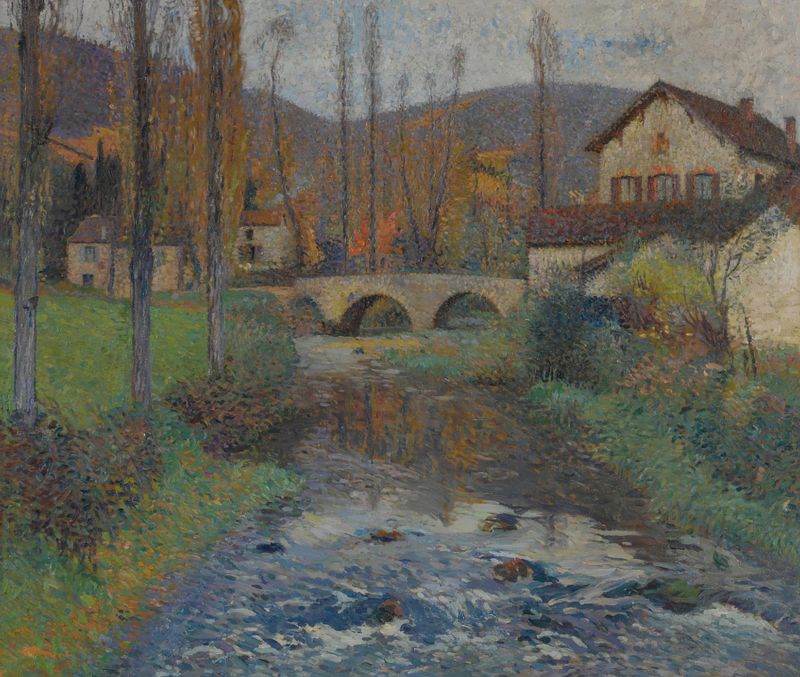
Le Pont du Labastide-du-Vert
Henri Martin

Le Pont de Labastide du Vert
Henri Martin

La Vallée Du Lot, Près De Saint-Cirq Lapopie
Henri Martin

Derniers Rayons, Une Ferme Dans Le Lot
Henri Martin
Le Lot au pied des falaises de St-Cirq-Lapopie
Henri Martin

Le lot aux pieds des falaises de Saint-Cirq-Lapopie
Henri Martin

L’église de Labastide-du-Vert avec le pont et la rivère, un soir d’automne
Henri Martin

Berger et ses moutons dans les causses
Henri Martin
Une allée dans le Parc du Château de Versailles
Henri Martin
Le Bassin et le tonnelle
Henri Martin





