
Vue du parvis de Notre-Dame — History & Facts
In the stroke of a brush, we find not just images, but echoes of moments and emotions suspended in the beauty of melancholy. First, look to the left at the grandeur of Notre-Dame, its intricate Gothic architecture rising majestically against a hazy sky. The light drapes softly over the stone façade, illuminating details that speak to centuries of history. Notice how the figures in the foreground—shadows of people moving purposefully—contrast with the stillness of the cathedral.
This juxtaposition of life against the permanence of stone encapsulates a world poised between the transient and the eternal. The emotional tension resonates subtly throughout the piece. While the cathedral stands strong and unyielding, the muted color palette evokes a sense of nostalgia and loss. The gentle strokes convey both the vitality of the bustling scene and a profound silence that lingers, as if the viewer is invited to reflect on the passage of time.
Each figure appears lost in thought, suggesting stories untold and lives intertwined with the history that surrounds them. Created in 1835, the artist worked amid the Romanticism movement, characterized by its emphasis on emotion and the sublime. Ferri painted this piece during a time of significant social change in France; the nation was grappling with the aftermath of political upheaval and the early stirrings of modernity. This intersection of past and present in Vue du parvis de Notre-Dame captures the essence of a moment when the weight of history meets the pulse of everyday life.
More Artworks by Domenico Ferri
Browse all →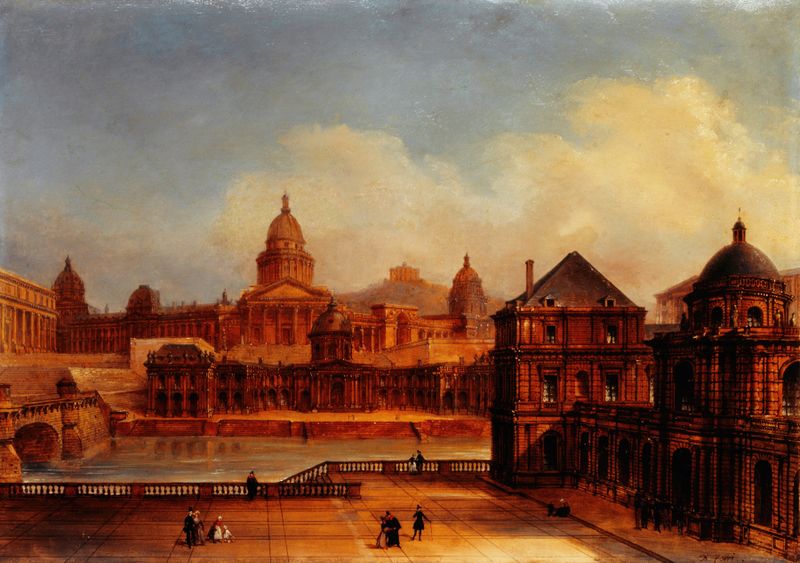
More Architecture Art
Browse all →
The statue of Liberty
Frédéric Auguste Bartholdi

View of Houses in Delft, Known as ‘The Little Street’
Johannes Vermeer

View of Houses in Delft, Known as ‘The Little Street’
Johannes Vermeer

The Cathedral in Rouen. The portal, Grey Weather
Claude Monet

The yellow house
Vincent van Gogh

The Church in Auvers-sur-Oise, View from the Chevet
Vincent van Gogh