
Waterval in Noorwegen DM 939 311 Dordrechts Museum — History & Facts
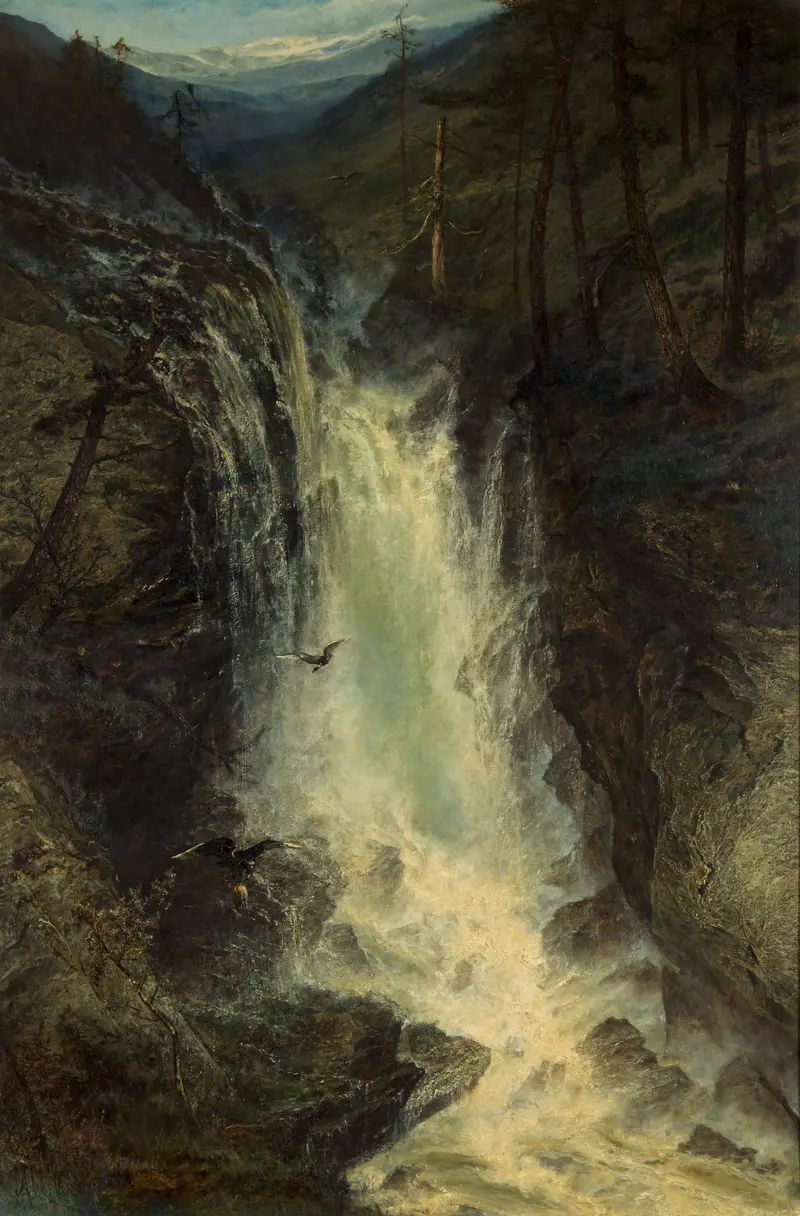
It is the force of the water that first grips the eye—a torrent bursting from the shadowed hills, white and alive against the deep, mossy greens and browns of the Norwegian landscape. The painter, Alexander Wüst, has chosen a vantage point that lets the viewer feel the plunge and spray, as if standing just close enough to sense the damp chill on their skin. The lone, bare tree leans precariously over the cascade, its twisted limbs echoing the wild, untamed energy of the scene.
Two dark birds wheel in the misty air, their presence both a scale for the waterfall’s height and a reminder of the rawness of this terrain. Light is used sparingly, but where it strikes the water, it becomes the painting’s true protagonist, drawing the gaze downward in a rush. Works like this, painted in 1871 and now held in the Dordrechts Museum, reflect a period when European artists were venturing into the wilds of Scandinavia, seeking landscapes that spoke of nature’s power rather than its gentleness. The late nineteenth century saw a growing fascination with remote and rugged places, fueled by new travel possibilities and a Romantic hunger for the dramatic.
Such paintings were often collected by a rising middle class eager to display both taste and a sense of adventure—landscapes as trophies of the imagination. History has kept few traces of Wüst’s own journeys, but in this painting, the world of 1871 comes alive in the rush and roar of falling water, inviting us to linger and listen.
More Artworks by Alexander Wüst

More Landscape Art

The Starry Night
Vincent van Gogh

View of Delft
Johannes Vermeer

Water Lilies
Claude Monet

The Grand Canal, Venice, looking north-west from the Ca' Corner to the Ca' Contarini degli Scrigni, with the campanile of Santa Maria della Carità
Canaletto

Windsor Castle
Canaletto

The Grand Canal looking North-East from the Palazzo Dolfin-Manin to the Rialto Bridge
Canaletto