
Wien in hundert Jahren — History & Facts
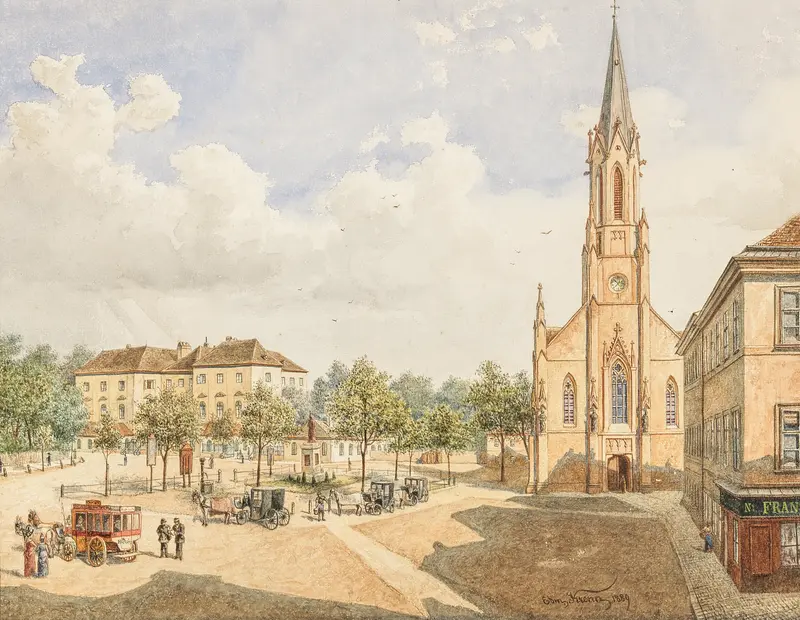
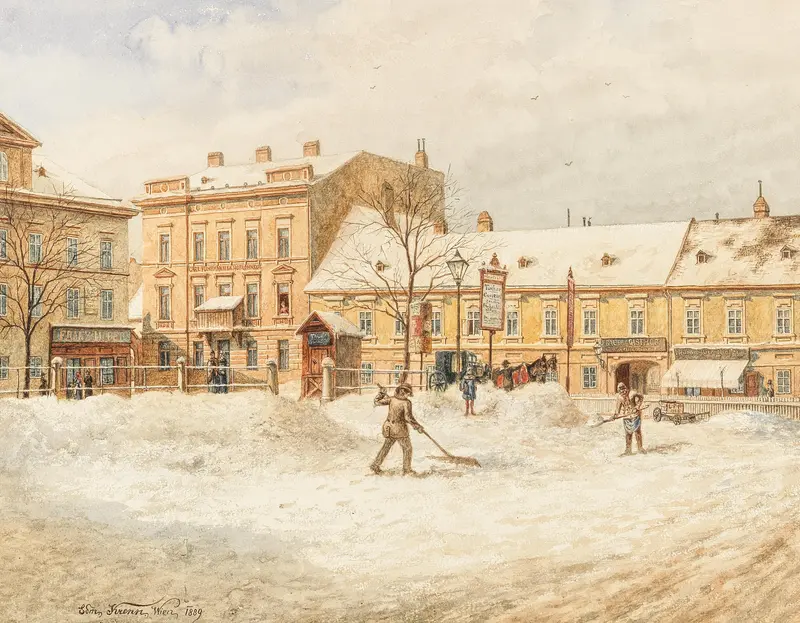
A reflection on time, it invites viewers to contemplate the duality of progress and nostalgia, while hinting at an underlying fragility that beckons exploration. Look to the center of the composition where the shimmering river reflects the enchanting skyline of Vienna, its domes and towers captured in golden hues. The artist employs a rich palette, where warm ambers and cool blues create a delicate balance that suggests both dawn and dusk. Notice how the swirling clouds echo the turmoil of change, while the meticulous brushwork gives life to architectural details, revealing a city caught in the tension between its storied past and uncertain future. Delve deeper into the contrasts present in this piece—the vibrant life reflected in the water juxtaposed with the static, towering buildings that stand as monuments to history.
Small figures dot the banks, seemingly oblivious to the looming shadows of a city struggling with its identity. Each brushstroke unveils layers of emotion, highlighting both the beauty of human achievement and the sorrow of what is inevitably lost over time. Created in 1887, this work emerged during a period of rapid transformation in Vienna, where the industrial revolution was reshaping the urban landscape. Edmund Krenn, influenced by the changing dynamics of society, sought to document not only the physical beauty of his city but also the underlying tensions that accompanied such growth.
Amidst personal and artistic developments, Krenn's vision captures a moment of reflection that resonates through the ages.
More Artworks by Edmund Krenn
More Landscape Art

Starry Night
Vincent van Gogh

View of Delft
Johannes Vermeer

Water Lilies
Claude Monet

The Grand Canal, Venice, looking north-west from the Ca' Corner to the Ca' Contarini degli Scrigni, with the campanile of Santa Maria della Carità
Canaletto

Windsor Castle
Canaletto

The Grand Canal looking North-East from the Palazzo Dolfin-Manin to the Rialto Bridge
Canaletto