Winter — History & Facts
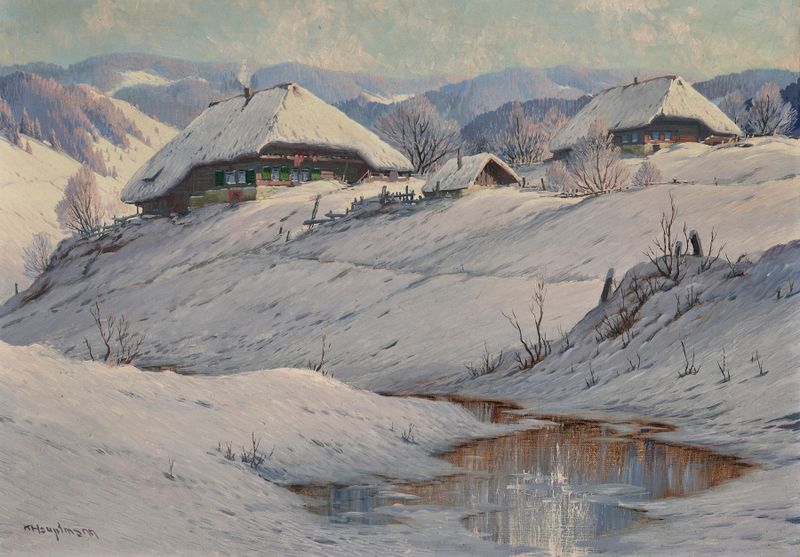
Who listens when art speaks of silence? In the hushed realm of Winter, a profound unease clings to the atmosphere, echoing the quiet depths of human fear. Look closely at the desolate landscape, where the stark white of snow contrasts sharply with dark, gnarled trees silhouetted against a muted sky. The composition is masterfully balanced, guiding your gaze to the horizon where the chill of winter seems to swallow sound itself. The artist's use of muted greys and deep blacks enhances the sense of foreboding, creating an interplay between light and shadow that evokes both serenity and dread. Within this frozen scene lies a poignant meditation on isolation.
The barren trees, stripped of their leaves, stand like sentinels, embodying a profound loneliness that mirrors our own inner fears. The untouched snow suggests a world waiting for something to break the stillness, hinting at the potential for both beauty and despair. Each brush stroke conveys a silent tension, drawing forth the viewer's own experiences of dread and solitude in the face of nature's indifference. In 1916, as the horrors of World War I ravaged Europe, Winter emerged from the studio of Karl Hauptmann, a time of chaos overshadowing personal introspection.
Living in Germany during this turbulent period, Hauptmann sought to capture the emotional landscape of his surroundings through his art. In a world rife with uncertainty, he turned to the stark beauty of winter, illustrating not only the season’s chill but also the chilling silence of the human condition.